
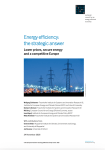
 Europe has paid a heavy price for not making energy efficiency a sufficiently strategic priority. A new report published by the European Council for an Energy Efficient Economy (eceee) on November 24th provides compelling evidence that earlier and more ambitious energy efficiency measures could have substantially reduced the economic damage caused by successive energy crises, while strengthening European competitiveness.
Entitled Energy efficiency: the strategic answer – Lower prices, secure energy and a competitive Europe. its central message is clear: energy efficiency is not simply a means of reducing energy bills or meeting climate targets. It is a strategic instrument for Europe’s economic competitiveness, energy security and long-term resilience.
The staggering cost of insufficient action
The report estimates that the four energy crises since 2022, together with the structural shift from pipeline gas to liquefied natural gas (LNG), have added €1,107 billion to the EU’s energy costs up to October 2026. This comprises:
- €590 billion from natural gas price increases during the crises;
- €223 billion from higher oil prices; and
- €294 billion from the structural shift from pipeline gas to LNG.
To put this into perspective, the total exceeds the estimated €900 billion investment required to implement the EU’s Energy Performance of Buildings Directive (EPBD) up to 2030.
The comparison is particularly striking. Investment in energy efficiency would have generated lasting economic, social and environmental benefits, supported domestic economic activity and reduced Europe’s vulnerability to future energy crises.
As Nils Borg, Executive Director of eceee, states:
“Efficiency has already protected Europe, but we have only used a fraction of its potential. We have paid for crises instead of investing in resilience.”
Energy efficiency has already made a difference
The report provides important evidence of what European energy efficiency policies have already achieved:
- Without the energy efficiency measures implemented since 2000, European industrial energy demand in 2025 would have been 36% higher;
- European manufacturing now generates 50% more value added with 25% less energy than in 2000;
- Strategic energy efficiency measures implemented between 2015 and 2021 avoided approximately €120 billion in additional natural gas costs during the period from May 2021 to May 2023; and
- Long-term strategic energy efficiency measures had an impact 3.4 times greater than emergency energy-saving measures introduced during the crises.
In a particularly thought-provoking scenario, the authors estimate that, had the EU’s 2030 energy savings target already been achieved by 2020, the additional energy costs associated with the subsequent crises could have been reduced to almost zero. Yes, read that again.
While this is a retrospective thought experiment rather than a forecast, it illustrates the potentially enormous economic value of acting early.
Energy prices are only part of the competitiveness equation
Much of the European competitiveness debate since the publication of the 2024 Draghi report on European competitiveness has focused on the high energy prices facing European industry compared with its international competitors.
Yet, as eceee argued in an earlier report in 2013, energy prices should not be confused with energy costs.
European industry has historically been able to compensate, at least in part, for higher energy prices through superior energy efficiency and productivity. The amount of energy required to produce a product or deliver a service is just as important as the price paid for that energy.
The new report takes this argument further. By reducing overall energy demand, energy efficiency can also help bring down market prices, benefiting even those consumers who have not themselves invested in efficiency improvements.
This is an important dimension of energy efficiency that receives insufficient attention in European energy policy discussions.
Energy efficiency and electrification must go hand in hand
The report also provides a timely contribution to the debate on electrification.
While electrification can deliver significant efficiency improvements, particularly through technologies such as heat pumps, it will also increase demand for electricity. Some industrial decarbonisation pathways, notably those involving renewable hydrogen and synthetic fuels, will require substantial additional electricity supplies.
Improving the efficiency of existing electricity uses – including industrial motor systems, appliances and other equipment – can free up capacity for the electrification of industry, transport and buildings.
Energy efficiency can also help moderate electricity prices, reduce pressure on electricity grids and limit the need for additional infrastructure investment.
Electrification, renewable energy and energy efficiency should therefore be seen as complementary strategies rather than competing policy priorities.
The multiple benefits of energy efficiency deserve greater attention
One of the most welcome aspects of the report is its emphasis on the wider benefits of energy efficiency, both at the economy-wide level and within individual companies.
At company level, energy management can reduce annual energy costs by more than 10% within three years on average. However, the benefits extend well beyond energy savings.
Improved productivity, reduced downtime and better resource utilisation can significantly strengthen the business case for investment. The report finds that, for every euro saved on energy, companies often gain another euro through these additional benefits. Taking them into account can reduce investment payback periods by almost half.
At the macroeconomic level, modelling using the MICATool estimates that energy efficiency improvements between 2020 and 2024 contributed approximately €319.5 billion in additional GDP, alongside significant employment, environmental and public health benefits.
These findings reinforce the need to integrate multiple benefits systematically into investment decisions, energy audits, energy management practices and public policy assessments.
This is particularly important for small and medium-sized enterprises, where energy efficiency investments must compete with other business priorities for limited financial resources.
Strengthening, not weakening, ‘Energy Efficiency First’
The report concludes with a series of recommendations for European and national policymakers:
- Make energy efficiency a strategic priority through ambitious, structural policies rather than relying on emergency measures.
- Act early and invest in resilience instead of repeatedly paying for energy crises.
- Support electrification through improved energy efficiency.
- Combine energy efficiency and renewables to reduce the influence of natural gas prices on electricity markets.
- Integrate the multiple benefits of energy efficiency into decision-making at both government and company level.
- Simplify and improve policy instruments, particularly for SMEs, rather than abolishing them.
- Retain and strengthen the Energy Efficiency First principle in EU legislation.
This last recommendation is particularly important in the context of the current European debate on regulatory simplification. Simplification should lead to more effective implementation and greater energy savings, not a weakening of the policy framework that underpins Europe’s long-term competitiveness.
Will Europe finally learn the lessons?
The eceee report complements the findings of the IEA’s newly published Energy Efficiency 2026, which also highlights the importance of translating short-term responses to energy crises into lasting structural improvements.
Together, these reports raise a fundamental question about the direction of energy policy.
Why do we continue to devote so much political attention and so many financial resources to securing energy supplies and managing the consequences of energy crises, while giving insufficient priority to reducing our underlying need for energy?
Europe’s competitiveness, energy security and decarbonisation objectives are not separate challenges. Energy efficiency is one of the few strategies that can make a significant contribution to all three simultaneously.
The evidence is increasingly compelling. The challenge now is to translate that evidence into political commitment, effective policies and sustained investment.
Europe cannot afford another €1 trillion lesson in the consequences of insufficient action on energy efficiency.
The report, Energy efficiency: the strategic answer – Lower prices, secure energy and a competitive Europe, brings together research from eceee, Fraunhofer ISI, the Institute for European Energy and Climate Policy (IEECP) and the EU-funded ODYSSEE-MURE project.
The report can be downloaded here.

