
Darius Snieckus writes on Canada’s National Observer website about the possibility of connecting Canadian and European electricity grids across the Atlantic to improve energy security, integrate renewable energy and balance electricity supply and demand.
Power technology giant backs plans for transatlantic clean electricity link to Europe
North America’s largest power technology company has formed a project “alliance” with the developers of a proposed 4,000-kilometre, high-voltage underwater electricity line that would link Canadian and European grids across the Atlantic.
Under the tie-up confirmed this week, GE Vernova, the company formerly known as General Electric, could supply a wide range of industrial equipment and technology for the $30 billion North Atlantic Transmission One – Link (NATO-L) project.
That could include grid infrastructure, transmission lines, substations, transformers and energy storage plants, said Oliver Ruiz, GE Vernova’s vice president for grid systems integration in Canada.
The company’s work on the project over the last nine months showed it was aligned with the global push toward electrification, and CEO Scott Strazik’s strategy “to build big things,” Ruiz said.
“There is a big push on to move GE forward as a company that can solve “big challenges’ in the global energy transition,” he told Canada’s National Observer on the sidelines of a Montreal meeting to update financiers, engineers, politicians and academics on the ambitious project conceived in 2022.
“Most of all, this means electrification. NATO-L is one of these projects,” Ruiz said.
In GE Vernova’s investor update last year, Strazik said the company would focus on “very complex projects in parts of the world that need substantial infrastructure build for their grid to work,” including offshore wind and transmission
“We could bring a lot to this project on the grid side but also for generation – offshore wind turbines, for example,” he said.
Long-distance high voltage experience
GE Vernova, which developed the Haliade-X offshore wind turbine used widely off the US and Europe coastlines, is also still involved in the stalled X-Link project, a multi-billion-dollar plan to connect solar power from North Africa’s Morocco to the UK grid via a 3,800-kilometre subsea line.
Ruiz said NATO-L could provide a major export line for future offshore wind power from Canada’s Maritime provinces. The region is still searching for “routes to market” for power that exceeds provincial needs, because a wider market is necessary for the sector to be financially viable at scale.
“Connecting Canadian wind to the European market would help reduce the cost of what is still — in the Maritimes — an expensive source of power,” he said. “In this context, NATO-L makes a lot of sense.”
The vision behind NATO-L is to transport huge volumes of electricity both ways across the Atlantic, using Canada’s vast hydropower network and growing wind power fleet to help balance Europe’s more volatile grid demand while smoothing electricity delivery on Canadian grids.
The six-hour time difference between the continents means that renewable power Europe doesn’t need at night could be sent west to meet Canada’s evening demand.
Europe is expected to have a surplus of clean energy production this year, according to Eurostat, the EU’s statistics portal. Canadian wind power, backed by hydro, could in turn be sent to Europe when it would otherwise be curtailed here.
NATO’s developers believe power could be flowing across the Atlantic as early as 2040.
Routes to EU market
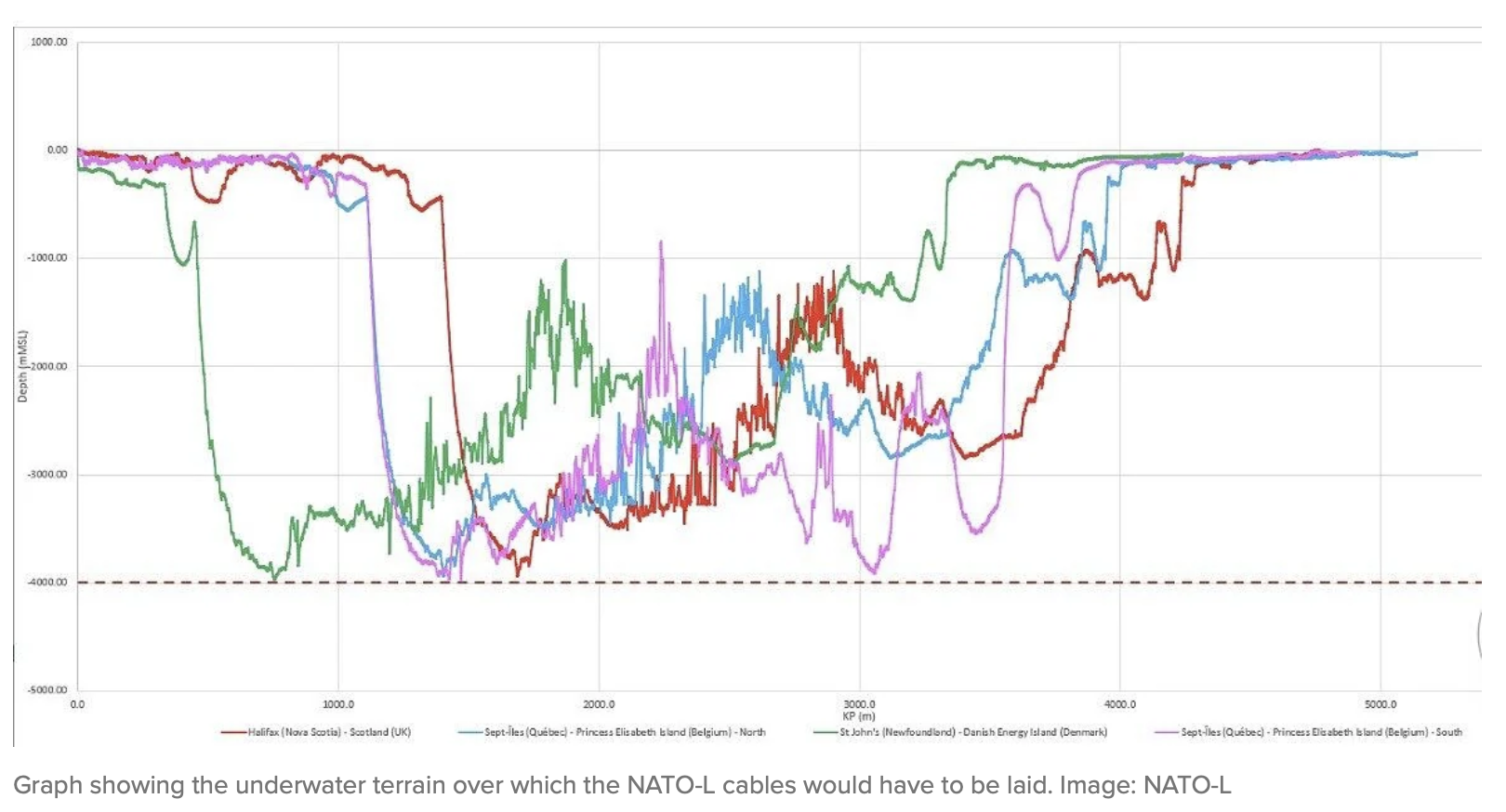
The GE Vernova tie-up follows an August announcement by the NATO-L developers, led by London-based investment banker Laurent Segalen, of a shortlist of four undersea routes that could be used for construction of one of the world’s biggest pieces of energy infrastructure.
The mapping was done by European offshore construction giant Jan De Nul. The company favours a route linking Sept-Îles, Qué., with Princess Elisabeth Island in Belgium, where an offshore “energy island” is being built for Belgian grid operator Elia. All the routes stay in waters less than 4,000 metres deep, the current limit for cable installation with today’s fleet of construction vessels.
“This project is a process and we are building the coalition — technical, engineering, financial, political,” Segalen told CNO, noting the company is in “active discussions with all the cable makers,” including Italy’s Prysmian, Paris-based Nexans S.A., and Denmark’s NKT.
The technical challenges are not insignificant, he said, but early studies by the consultancy DNV and more recent number-crunching by GE Vernova have “cracked the code of the route cabling and the designs” of the continent-bridging line.
The project’s early-stage project financiers, which Segalen described as “medium-sized infrastructure funds with around $10 billion in asset management,” are “very willing” to carry the capital cost of NATO-L.
What’s missing for the project to launch, he added, is a “modest but meaningful intervention” from the federal government that would send a market signal to prospective European investors.
“Send me a nice letter saying, ‘We, Canada, are interested.’ That’s it. ‘Interested.’ Go and do a good job,” Segalen said.
Alliance for the Future ‘spark’?
He said the recent unveiling of the EU-Canada Alliance for the Future should boost NATO-L’s chances, adding that he has been discussing the project’s financing with the European Investment Bank.
“We need a bit of a spark on the Canadian side so we can put you on the list of major [joint Canada-EU] projects being considered,” Segalen said the bank told him.
“The moment Canada shows an official rather than unofficial interest in the project, that is going to trigger all the money that we would need out of Brussels,” he added.
Neither the federal nor provincial governments responded to requests for comment on NATO-L’s potential for referral to Canada’s Major Projects Office, which fast-trackedthe Pacific Link oil pipeline.
Undersea cables spanning the Atlantic have been laid since 1866, when the first permanent telegraph line was reeled out from Britain to the US. A pioneering telephone trunkline, known as TAT-1, was installed on the seabed 90 years later.
Although HVDC power lines like NATO-L are more technologically complex and costly than telecommunications cables, the planned transmission line is one of a growing number of long-distance HVDC mega-projects in development around the world today, including the 5,100-kilometre AAPowerLink that would connect Australia to Singapore.
External link


A pathetic fantasy. One would think that GE would focus on more
immediate actions, e.g. making regional networks more resilient to AI
enhanced cyber attacks.
I agree that it is a fantasy. I’m sure, however, that GE is also focusing on those immediate actions.