

The Financial Times, a newspaper of record for business and politics, has become almost passionate about climate change. “Even now, when weather records are being broken, when climate change is demonstrably here, not in the future, we seem frozen. We still go about our carbon-greedy lives: snapping up the last air-conditioning unit, booking another flight, seeking solace in the pathetic fallacy of recycling things we maybe didn’t need at all. It’s not that we don’t care.” Writing in the Financial Times, the British journalist, Camilla Cavendish, Baroness Cavendish of Little Venice wonders how we are to “shake ourselves into action.” She ends with a critical message to all of us: “Climate change is the great leveller. Wealth can’t protect us from it. Certainly, the rich can remain more comfortable than the poor, especially those trying to scratch a living from parched soils. But our fates, and those of our children, are all linked. This week, across the west, people stood in parks and on roofs to watch the eclipse together. We all know the sky is changing. We need to stop waiting for someone else to break the spell and start to do the things we know we should.”
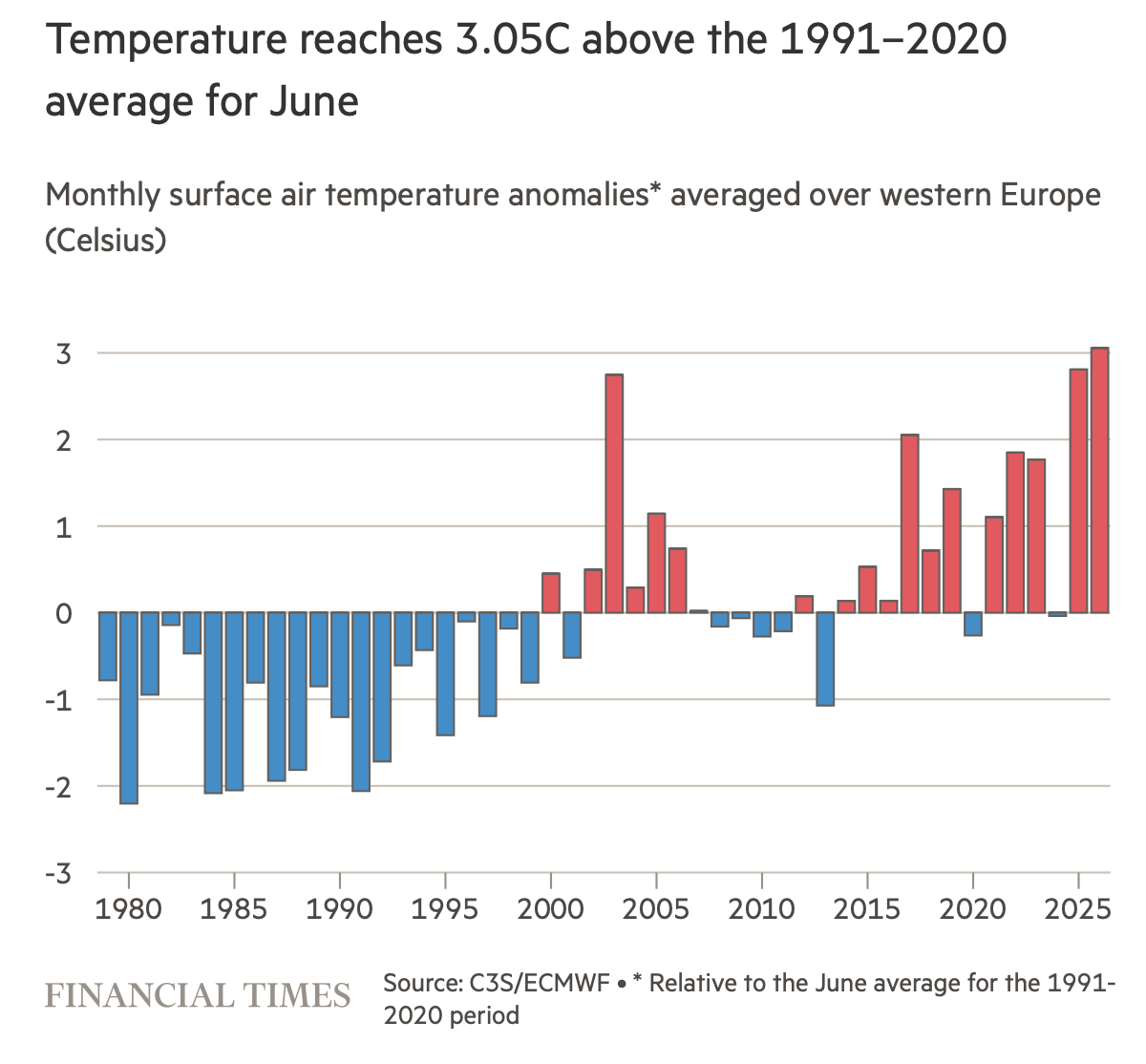
The Financial Times questions whether Europe is prepared for a world of extreme heat. Just look at the data from June in following graph. Cavendish surely is right. What is happening is not a wake-up call. It’s a slap in the face.
The blockade of the Strait of Hormuz and the Bab al-Mandab Strait into the Red Sea are severely affecting the transport of fossil fuels and other vital products globally. The Financial Times reports that “Sea Legend, a Chinese container shipping company focusing on the Turkish and North African markets, will this week launch the first regular container shipping service through the Arctic. . . . The company has branded the service the “Ice Silk Road” in reference to the Silk Road trading route that once connected China and Europe.” No doubt there are concerns. The FT continues: “The impact of global warming in the Arctic is quite staggering,” said former Canadian environment minister Steven Guilbeault, who is sailing across the Arctic to raise awareness of issues affecting the far north. “Climate change will enhance security risks in the Arctic, particularly if there are more and more vessels in the Arctic which are not necessarily from Arctic nations.” No doubt we’ll hear more about this. Hopefully not about oil spills and other forms of pollution.
The Financial Times also reports on the impact of AI on the energy sector. “AI-driven productivity gains in the oil and gas industry will substantially increase global emissions, according to a report led by two former Microsoft employees, outweighing any potential gains from clean energy.” While AI will help produce more renewable energy, “the peer-reviewed report published in the journal Nature this week finds these emissions savings would be offset by AI expanding fossil-fuel supply. . . . If AI adoption spread across all energy sectors, it could add between 0.5bn and 1.8bn tonnes of carbon dioxide to the atmosphere every year, according to the authors of the report, who are affiliated with Enabled Emissions Campaign, a climate advocacy group.”
In planning travel over the upcoming weeks, here are some useful ideas to help you along:
- Check out the Good Night Train website for the unique way to travel through Europe while you sleep.
- There’s never been a more important moment to travel right in Europe with masses of overdevelopment, cruise ships, walking pollution and captive cetaceans still hot topics when it comes to responsible tourism issues in Europe. Check out the Responsible Travel website.
- World Walks provides us with walking holidays in Europe.
- Here are 15 remarkable mountain peaks in Europe to conquer in summer.
- Cycling for Softies provides us with the 15 best cycling holidays in Europe in 2026.
William Shakespeare (1564-1616), English playwright, poet and actor, widely regarded as the greatest writer in the English language and the world’s pre-eminent dramatist, captures the mood for mid-August (from Sonnet 18): “And summer’s lease hath all too short a date.”
EiD welcomes your views about this week’s selection of posts on the zero-carbon energy transition:
- The price of delay: how climate inaction fuels inflation
- The new energy security: less waste, more resilience
- The climate has changed. Now our cities must change too
- Can solar farms feed both AI and us?
- The growing cost of climate-proofing France’s energy system
- Energy storage: Europe’s missing link to energy security
- Batteries: a threat to the grid or the key to its future?
- Europe looks south for its clean energy future
- Small reactors, big promises — but can SMRs deliver?
Please send your comments on any of the posts. Please recommend EiD to your friends and colleagues.
If you know anyone who would like to receive this weekly notice, please invite them to contact EiD at news@energyindemand.com. It is not available on the WordPress website.

