
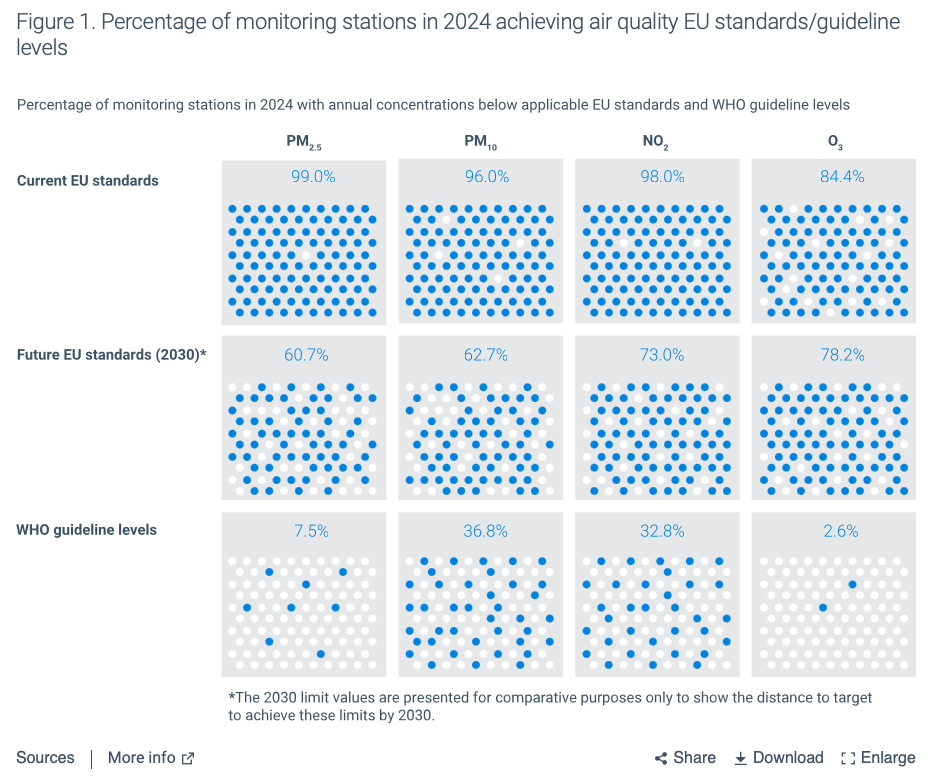
Most air quality monitoring stations in Europe achieve current EU legal standards for key air pollutants. However, the levels of key pollutants — like particulate matter, benzo(a)pyrene and especially ground-level ozone — remain a significant problem, according to the latest air quality assessments published this week by the European Environment Agency (EEA).
Progress in improving Europe’s air quality, but further action needed to address 2030 limits, ground-level ozone
Latest data collected and analysed for 2024 and 2025 shows EU standards were mostly met in most regions across Europe for fine particulate matter (PM2.5) and for nitrogen dioxide (NO2). However, in up to 20% of monitoring stations, air pollution is still above current EU air quality standards, especially for smaller particulate matter with a diameter of 10 microns (µm) or less (PM10), ground level ozone (O3) and benzo(a)pyrene (BaP).
The EEA Air Quality status report 2026 presents the latest official reported data on levels of key air pollutants in Europe. It compares these concentrations against current and 2030 EU air quality standards and the World Health Organisation (WHO) health-based air quality guideline levels.
The new air quality standards applicable from 2030 will require Member States to maintain and increase measures to address air pollution. Across the majority of Europe air pollution levels also remain above the stricter WHO guideline levels set to protect human health.
Action on ground-level ozone needed
Ozone is of particular concern, according to a separate EEA briefing — ‘Addressing ground-level ozone pollution in Europe’. It says that ground-level ozone levels have not decreased significantly, despite overall reductions in emissions of key ozone precursors pollutants.
This complex pollutant is formed in the lower atmosphere when sunlight triggers photochemical reactions between ozone forming pollutants, like nitrogen oxides (NOₓ) and volatile organic compounds (VOCs). As a result, reducing ozone levels is more challenging than reducing other major air pollutants.
The briefing warns that climate change is expected to worsen ozone pollution in Europe because of increased frequency and intensity of heat-related meteorological conditions that enhance ozone formation.
Ground-level ozone is a strong oxidant and can damage both human health and the environment with latest data showing that 63,000 deaths can be attributed to it in the EU as well as causing billions of euros of damage due to crop losses. It also plays an important role as a driver of climate change, as it is a greenhouse gas (GHG).
The briefing stresses further action by Member States is needed under the EU’s revised Ambient Air Quality Directive to address ozone pollution. However, action at national and local level alone may not be sufficient. Ozone and its precursors can travel long distances, meaning that effective mitigation also depends on stronger European and international cooperation to tackle transboundary air pollution.
A better understanding of the role of the different key ozone forming pollutants that make up ground-level ozone would help to better identify the best way to reduce ozone levels.
To support more effective air quality planning, new analytical tools can help cities and countries better understand what drives ozone pollution. A new interactive dashboard integrated into the EEA city viewer allows users to explore sector‑by‑sector contributions to ozone during the peak season, based on 2024 data. In parallel, EU-27 country factsheets offer a clear picture of ozone levels, trends and future projections in each Member State.
Risk to health and the economy
Air pollution remains Europe’ s greatest environmental health risk. It reduces quality of life, causes diseases and leads to preventable deaths.
Further reductions are still needed to meet current EU standards but also new EU standards set for 2030 under the EU’s revised Ambient Air Quality Directive. For some pollutants the distance to the 2030 standards is significant. This is especially the case for particulate matter (PM); in 2024 30% or more of the reported monitoring stations recorded particulate matter concentrations above the revised standards, the EEA analysis says.
Also importantly, for most pollutants, air pollutant concentrations remain well above the levels established by the WHO air quality guideline levels, with more than 9 out of 10 Europeans exposed to air pollution concentrations above those particulate matter (PM2.5) and ground-level ozone (O3) levels, especially in cities.
Reducing air pollution reduces impacts on health and associated economic costs such as healthcare, reduced productivity and absenteeism caused by pollution-related illnesses.
To achieve the targets, from 2026 onwards Member States will be required to implement air quality roadmaps for pollutants where the concentration is above the level specified in the revised 2030 standards.
The revised EU Ambient Air Quality Directive significantly tightens air quality standards, aligning them more closely with WHO recommendations.
Background
The EEA report is the first in the EEA’s ‘Air quality in Europe 2026’ package. Later this year, the EEA will publish the data on the impacts of air pollution on human health. This includes estimates of premature deaths and ill health that can be attributed to poor air quality.
The EEA analysis covers 39 countries, including the 27 EU Member States, the five other EEA member countries (Iceland, Lichtenstein, Norway, Switzerland and Türkiye), six EEA cooperating countries (Albania, Bosnia and Herzegovina, Kosovo under the UNSCR 1244/99, Montenegro, North Macedonia and Serbia), plus voluntary reporting from Andorra.
External link

