
In an article on the National Observer website, Darius Snieckus writes about one Quebec pension fund investing in clean energy. It is the particular Quebec model: long-term “patient capital,” a dual mandate combining returns with provincial economic development, and an increasing emphasis on investing in real-world decarbonisation rather than simply divesting high-carbon assets.
Quebec pension giant bets on ‘patient capital’ to build clean energy future
When Emmanuel Jaclot was interviewed in 2018 for the top infrastructure and sustainability job at Quebec pension fund La Caisse, he posed a pointed question to then-CEO Michael Sabia.
How was Canada’s second-largest pension fund doing on the ambitious climate targets it had unveiled the year before? The pension fund had announced a 50 per cent increase in low-carbon investments and a 25 per cent reduction in the carbon footprint of its global portfolio, both by the end of the decade.
“How are things progressing on this front?” he asked Sabia who, after La Caisse, ran utility Hydro Quebec for several years before being named last year by Prime Minister Mark Carney to run Canada’s civil service.
Sabia responded in a reassuring voice: “It’s coming, it’s coming.” Seven years later, the pledge has proved sound — and Jaclot, who got the job, is one of the main reasons why.
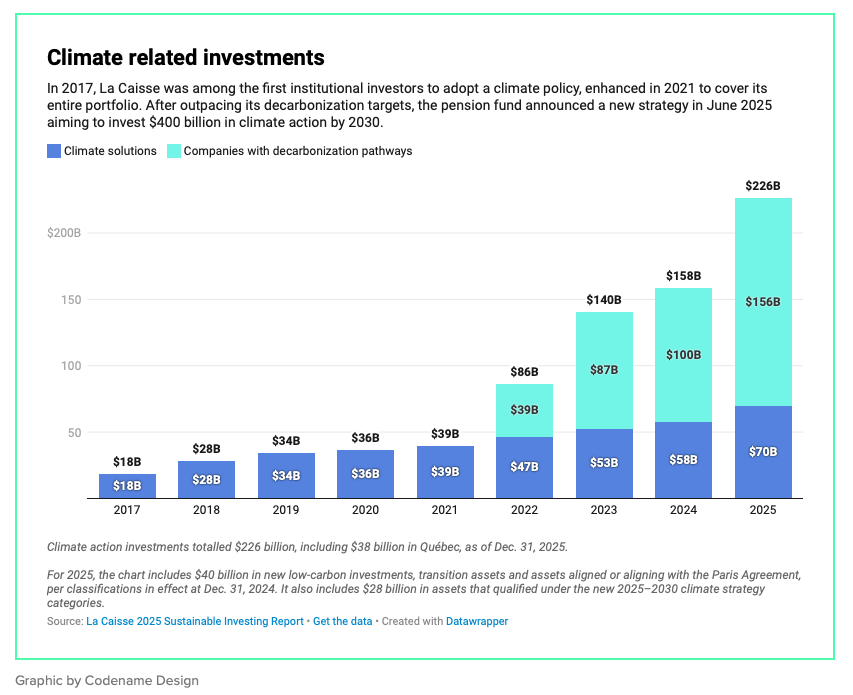
Under his watch, Montreal-based La Caisse, Canada’s second-largest pension fund after the Canada Pension Plan Investment Board (CPPIB), has far outpaced its original climate action ambition and deployed $226 billion in climate-related investments globally, including $38 billion inside Quebec.
La Caisse has $552 billion in total assets under management as of June 30, with $100 billion invested in its home province. In the first half of 2026, it posted a 5.1 per cent average return, short of its benchmark 7.5 per cent gain, due to small losses in its private equity investments.
Over the last seven years, Jaclot has built what has become one of the more progressive climate-investment machines among the world’s institutional investors.
Last year, La Caisse went further, unveiling a roadmap to put another $400 billion into climate-action and renewable energy assets by the end of the decade.
The pivot in the fund’s mission — overseen by Jaclot — now appears prescient of the wider rethink emerging globally in how major institutional investors are weighing up capital allotment in the face of climate change.
He attributes the success of the strategy in some part to what he calls the “unusual” mandate of the pension fund: to boost returns for its client-base while creating economic growth in Quebec.
This has led it to balance a widening stream of investment in companies with credible decarbonization plans and direct investments in climate solutions, including technologies such as wind and solar.
“We have a dual and unique mandate,” he told Canada’s National Observer, comparing La Caisse’s strategy to peers such as the CPPIB, which manages funds for the Canada Pension Plan, and the Ontario Teachers’ Pension Plan.
“The first mandate is obviously to optimize the risk-and-return for our clients,” Jaclot said, “but then there’s a second mandate, which is to support the economic development of Quebec.”
“So immediately, this creates a need to think through things differently than just maximizing returns,” he added.
‘Extended time horizon’
Pairing the dual mandate with what Jaclot calls “the luxury of a slightly extended time horizon” across the fund’s private market asset classes has made it possible for La Caisse to make investment bets that look beyond short-term market volatility based on the energy transition being a key driver of Canada’s industrial transformation.
“It’s a long-term mindset that is embedded in what we do, what our clients want us to do, the way our employees are paid,” Jaclot said.
The investment question the fund keeps returning to, he said, is not how an asset is currently performing financially, but “what happens to the assets that we purchase — especially private assets — how they perform, not just tomorrow but decades from now.”
That “patient capital” mindset has paid off. When La Caisse drew up its first climate “stewardship investment strategy” in 2017, institutional capital had only just begun to flow into the energy transition, meaning climate and renewables asset valuations were not overpriced.
This opened the door for Jaclot’s team to jockey quickly for market advantage before asset prices climbed sharply.
“This was early on in the energy transition, which was the best time to invest,” he said. “It helped a lot in getting good returns as well, because we’ve definitely benefitted from being an early mover.”
The clearest evidence of the benefit of being fast out of the gates was seen in the 2025 takeover of Innergex and Boralex, two Quebec-based renewable energy players, in deals worth a combined $13.8 billion.
Together these acquisitions will add 8.5 gigawatts (GW) in wind, solar and hydropower assets to the La Caisse portfolio, and large pipelines of clean energy projects in development.
“This investment perfectly illustrates our constructive capital and dual mandate in action: while we strive for optimal returns, we are committed to supporting essential businesses headquartered in Québec, which plays a key role in the energy transition,” Jaclot said at the time of the Innergex deal in Feb. 2025.
Seen through the lens of underwriting infrastructure projects, Jaclot said the utility-scale wind and solar assets core to the Innergex and Boralex portfolios offered “predictable cost structures” that are superior to traditional fossil fuel developments.
“The modularity [of wind and solar], the fact that much of the manufacturing is factory based, so costs are more predictable, more manageable,” said Jaclot, a graduate of the prestigious Mines Paris university who held senior positions at French energy giants Schneider Electric and Electricite de France before joining La Caisse.
“I think it’s a winning proposition, compared to many [fossil fuel projects] which are complex to build and for which the economics is determined by often volatile market forces,” he said, “such as in the Strait of Hormuz’s impact on oil trading” after the US launched its war on Iraq.
From carbon divestment to ‘patient capital’
The dramatic shift in its investment approach set out last year, underpinned by $400 billion in capital to spend by 2030, moved La Caisse from a risk-reduction model focused on auditing portfolio carbon footprints and jettisoning emission-intensive assets, to an operator-led strategy targeting “economy-wide” decarbonization.
Rather than exit heavy-emitting industries to artificially “scrub” its balance sheet, Jaclot said, La Caisse is putting “patient capital” to work in companies in carbon-intensive sectors that commit to science-backed decarbonization pathways. The pension fund also aims to control utility-scale clean energy platforms across North America and Europe.
While La Caisse surpassed its early climate investment goals — with its global low-carbon holdings growing to $58 billion, including $15.5 billion in Québec — Jaclot and his colleagues recognized that divesting from emissions-intensive companies to shrink the fund’s portfolio carbon footprint would be an “on-paper win” that failed to reduce real CO2 emissions.
“Our first climate strategy was around looking at the carbon footprint of our portfolio and ways to decrease it,” he said of the initial 2017 plan that changed dramatically last year.
“The philosophy became focused on climate action where we invest in companies and make sure they have a decarbonization strategy with clear 2030 and 2050 objectives based on SBTi,” he said, referring to the industry-setting Science Based Targets Initiative.
In practice, that means La Caisse is now willing to hold, and even acquire stakes in, carbon-intensive businesses — so long as they can show a “credible, externally verified” path to net-zero, he said.
This shift is the engine of La Caisse’s current capital deployment, with $156 billion invested in decarbonizing heavy-emitting businesses with SBTi transition plans, along with $70 billion invested in climate solutions and $65 billion in other low-carbon holdings.
Future continental power shortage
La Caisse’s infrastructure investment strategy is being fundamentally shaped by the structural reversal now under way in North American and many international energy markets.
For decades, the challenge for governments and their power plant fleet operators was to manage surpluses of electricity generation. Now the opposite is true: surging electricity demand driven by grid electrification, decarbonization of heavy-emitting industry, reshoring manufacturers, and the runaway growth in hyperscale data centre construction.
“It is no different in Quebec, where historically there has been a massive overcapacity of energy [from hydropower] and now we’re more constrained,” Jaclot said. “Everybody is forecasting demand for more capacity, more power.”
The solution, he said, must marry a major build-out of power plants with a greatly expanded grid.
While additional generation is key to meeting fast-growing demand in the coming decades, Jaclot argues new interprovincial transmission lines should be “an urgent policy and capital priority” because this would allow regions to smooth the variability of wind and solar power generation.
“Interconnection between countries or regional loads is the best way to deal with the intermittency that you have in renewables. You have seen this in Europe, and it will be equally true here in Canada,” he said.
Interconnection is among the first necessities in accelerating the energy transition in Canada,” he said, adding the federal government also recognizes it as “one of the quickest, cheapest, best ways to lower energy prices while better linking the various provinces.”
Clean power for industrial growth
He points to the $70 billion Newfoundland and Labrador deal recently signed — 14 GW of hydro and wind capacity wired into hundreds of kilometres of new transmission lines that will help green critical mineral mining and other sectors in the provinces — as a model for how “clean power to decarbonize industry and build new low-carbon industry.”
Yet, the largesse of private capital has its limits, Jaclot said, and cannot alone fund the “massive” infrastructure build that will be needed for future industrial “corridors” that carry no guaranteed return.
“The private investor cannot take the risk that there will be, for example, five critical mineral mining projects developing in a given region, and they will be the ones building the rail or roads or power lines,” he said.
“There needs to be a bit of support from the provincial and federal governments to make this happen. But then it’s win-win for these developers and the industries benefiting from clean energy,” Jaclot added.
The global energy transition is being driven less by “environmental imperatives” and more by the urgency of energy security and sovereignty, he said, and this shift will have mixed consequences.
For one, as trade wars and policy changes complicate the global transport of industrial equipment and raw materials, nations like Canada need to focus on rapidly developing local cleantech supply chains that spur economic development and jobs, he said.
“Importing all the wind and solar and battery equipment in the long run is dangerous, with tariffs that could be imposed on that journey along the supply chain and into construction and operation,” he said.
“I think for the social acceptance of these renewables projects, having the economic development and the job creation that would come in Canada, related to these assets, it’s going to be an increasingly important issue,” he added.
This informs how La Caisse structures its deals in Quebec.
The fund finalized a “strategic financial partnership” with the Mohawk Council of Kahnawà:ke last year to co-invest in renewable infrastructure, part of a broader effort to secure social license and long-term buy-in through direct equity stakes with Indigenous communities, rather than treat consultation as a box-ticking exercise.
Climate report card
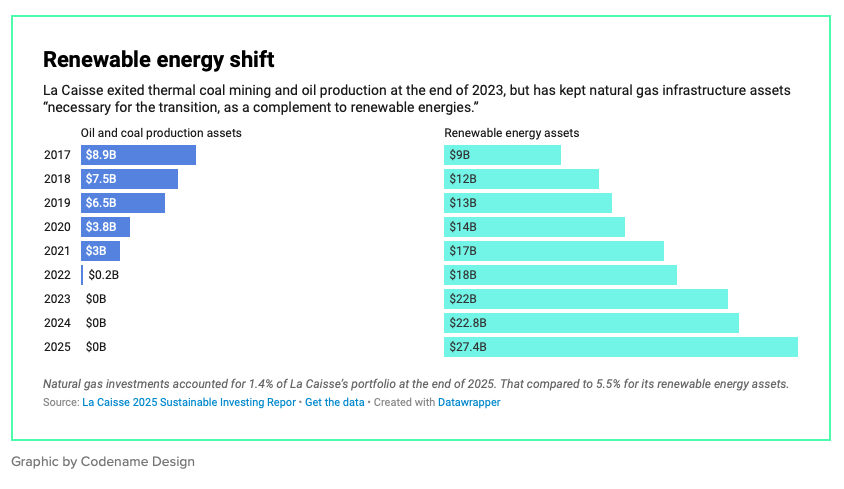
While La Caisse has fully divested its holdings of all coal, oil and related infrastructure, it has not completely severed ties to “old energy,” Jaclot said.
Natural gas infrastructure still accounts for 1.4 per cent of its overall portfolio, with another 0.4 per cent in gas distribution, primarily through its stake in Énergir, a Quebec utility with interests in several gas pipelines and storage facilities.
“Natural gas is still a transition asset and one that is probably going to be around longer than many of us originally anticipated,” Jaclot said, referring to the industry view of the role of gas as a transition fuel in the shift to renewables.
Despite those gas holdings, La Caisse topped Canada’s 11 major pension funds with an overall A- score in the latest report card by pension watchdog Shift Action.
“La Caisse continues to grapple with the inconsistencies remaining with its own gas investments, but overall the fund is showing leadership on what climate-safe investing looks like in 2026,” executive director Adam Scott told CNO.
La Caisse’s investment approach is in sharp contrast with peers who partnered with Ottawa to host a recent global investor summit in Toronto, Scott said, noting the investor pitchbook included a dozen major new fossil fuel export infrastructure projects.
Prime Minister Mark Carney has urged Canada’s pension funds to invest more at home, including private investment in four airports. There is speculation that pension funds will also backstop domestic LNG and pipeline projects.
Scott said none of the new fossil fuel export projects fit the financial risk profile required for pension investment, and would need hefty government subsidies and/or derisking to move forward.
“The best returns for their members come from long bets on the winning side of the energy transition — not betting on the losing side — as funds like CPPIB continue to do,” Scott said.
Taking a longer view
While terms such as ‘climate,’ ‘sustainability,’ and ‘ESG’ have fallen out of favour since Donald Trump’s return to the White House, Jaclot said La Caisse has moved climate analysis out of a specialized ESG compliance function and embedded it into its investment teams.
“We trained our 500 employees that do investment across all the asset classes on ESG topics, and now it’s embedded in those 500 people to look at those aspects,” he said.
“It’s not about one member of the team that is in charge of pushing this agenda: all these La Caisse employees and the investors that are our clients are conscious of the risk return of these different parameters.”
Ultimately, Jaclot said: “It is about convincing the companies we speak with that it is the right thing to do for financial and climate reasons, and getting as many people onboard because this is how we are going to affect climate for the better.”
Eight years into his role at La Caisse, Jaclot is clear-eyed about Canada’s energy transition and the challenge to reach a 2050 net-zero emissions target which the federal government remains committed to, despite the country being well off-track.
“All governments, ours included, have to deal with often unforeseen, short-term priorities — political, economic and so on,” he said.
“Pension funds can take a slightly longer view, to balance the immediate investment demands while factoring in the reality of positioning our portfolio for where the world looks to be heading,” he added.
Whether that long view proves influential, he admitted, is still an open question.
“We are trying to lead in climate-action investment,” he said. “Will others follow? We shall see.”
External link

