
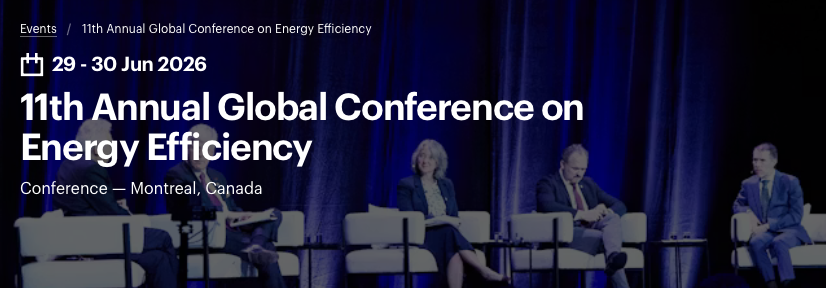
Energy efficiency was definitely front and centre for many this week, starting with the International Energy Agency’s 11th Annual Global Conference on Energy Efficiency in Montreal, June 29-30th. There were around 600 attendees from 60 countries. There were 40 ministers or heads of delegations, with about 25 at the ministerial level. There were about 70 CEOs from leading companies.
Co-hosted by the Government of Canada, ministers and senior officials from all continents said recent disruptions to global energy markets following the war in the Middle East had reinforced the need to accelerate energy efficiency as one of the quickest and most effective ways to lower energy costs, strengthen energy security and reduce exposure to future market volatility.
Let’s take a step back because there were important messages at the start of the two-day conference.
Fatih Birol opening conference
The beginning of the two day event set an important marker for where we are in energy efficiency. Fatih Birol, Executive Director of the IEA, argued that the world is entering a new phase of the global energy transition shaped by heightened geopolitical tensions and the search for trusted energy partners. Reflecting on recent energy crises, he noted that the price shocks following Russia’s invasion of Ukraine and the conflict involving Iran have exceeded those of the oil crises of the 1970s, prompting governments and businesses to rethink supply chains, technologies, trade relationships, and energy security. He praised Canada as a reliable democratic partner that is well positioned to play a larger role in the evolving global energy landscape.
A central message of the speech was that energy efficiency is receiving renewed momentum because of security as well as economic concerns. Birol pointed out that more than 40 countries are already implementing IEA recommendations to reduce energy demand and improve efficiency, arguing that history shows major energy crises often trigger lasting improvements in energy productivity. Drawing parallels with the 1970s oil shocks, he highlighted dramatic gains in the efficiency of buildings, vehicles, and industry that followed those crises and predicted today’s challenges could produce a similar transformation.
Looking ahead, Birol stressed that electrification will be essential for achieving a secure, affordable, and sustainable energy system, but warned that high electricity prices remain a major obstacle. To address this, he announced a new IEA ministerial advisory panel on electricity affordability, bringing together governments to develop practical policies to lower electricity costs.
Concluding with a quotation from Montreal-born singer-songwriter Leonard Cohen—”There’s a crack in everything, that’s how the light gets in,” Birol expressed optimism that today’s crises can become the catalyst for building a more resilient, affordable, and sustainable global energy system.
Two Canadian ministers give strong endorsement to improved energy efficiency
Birol was followed by two Canadian ministers, Tim Hodgson, Minister for Energy and Natural Resources, and Julie Dabrusin, Minister of Environment and Climate Change.
Minister Hodgson highlighted energy efficiency as one of the fastest and most cost-effective ways to improve energy affordability, reliability, and security at a time of global uncertainty and rising electricity demand. He stressed that using energy more efficiently lowers costs for businesses and households, strengthens national resilience, reduces pressure on energy supplies, and improves productivity while supporting economic competitiveness. Hodgson positioned energy efficiency as a central pillar of Canada’s forthcoming National Energy Strategy, alongside investments in a reliable, connected, and modern energy system.
Minister Dabrusin emphasised that energy efficiency and electrification are central to making energy more affordable, improving energy security, and reducing emissions. She highlighted Canada’s participation in the Global Electrify Now Initiative and stressed that clean electricity is one of the most effective responses to today’s energy challenges.
European Commissioner Dan Jørgensen addresses clear challenges
Commissioner Dan Jørgensen emphasised that energy policy is now central to addressing Europe’s three biggest challenges: affordability, climate change, and security. He noted that since the outbreak of the Iran conflict, Europe has spent more than €50 billion extra on energy imports without receiving any additional energy, while record-breaking heatwaves and Russia’s war against Ukraine underscore the urgent need to reduce emissions and strengthen energy independence. Jørgensen argued that the solutions are already available. Rapid deployment of renewable energy, improved energy efficiency, and widespread electrification can simultaneously lower energy bills, enhance competitiveness, cut greenhouse gas emissions, and reduce dependence on imported fossil fuels. He stressed that energy efficiency should be at the heart of all energy policy, pointing out that using energy more efficiently is a common-sense objective regardless of one’s views on the future energy mix.
Dan Jørgensen made two related points about planning across the European Union:
- The need for coordinated planning across all 27 Member States. He argued that Europe’s response to today’s challenges—high energy prices, climate change, and security—cannot be fragmented. Energy efficiency, renewable energy deployment, electrification, and grid investments need to be planned and implemented across all 27 Member States rather than through isolated national efforts.
- Planning around energy independence. Drawing on his experience as Denmark’s energy minister after Russia’s invasion of Ukraine, Jørgensen said Europe had learned the hard way that dependence on imported fossil fuels creates strategic vulnerability. He argued that every Member State should incorporate energy efficiency and renewables into long-term planning so Europe becomes more secure, competitive, and resilient.
He concluded by praising the IEA for its leadership in providing data and policy guidance, and called on governments, businesses, and other stakeholders to work together to put energy efficiency at the centre of public debate and policymaking. Quoting a famous hockey saying, he ended with the message that “you miss 100% of the shots you don’t take,” urging decisive action rather than delay.
These important presentations set the stage for the two-day conference. For more information on the IEA’s global energy efficiency conference, check out the IEA’s web page on the event.


Thank you for this genuinely informative resume of the speeches regarding how they value energy efficiency , made by some of the leading political figures attending.
Even so, the cynic in me wonders just how often such sentiments are also expressed at energy events NOT focused entirely around energy efficiency?I suspect that in most cases we may know the answer….