
Cynthia Mitchell writes a good article on the Greentech website on why California needs a new approach to address improving energy efficiency. What are needed are better markets, not programmes and a strong rate design, not more rebates.
Why California Needs to Think Differently About How It Supports Energy Efficiency
The imperative to change the way California implements energy efficiency is compelling and immediate. California’s energy efficiency programs are not meeting today’s grid-scale and local distribution service challenges, nor are they capable of supporting the state’s climate goals.
Even with the state’s massive ratepayer-funded efficiency programs since the 2000-2001 energy crisis, energy use and peak loads have increased, and they are forecast to continue to grow. Peak demand (absolute and per capita, noncoincident) has been increasing and is projected to increase at rates greater than the growth in energy consumption. The state’s most important tool for addressing greenhouse gas emissions in the energy sector is energy efficiency.
However, about one-third of California’s annual efficiency savings since 2000-2001 has been achieved from short-lived fluorescent lamps. As a result, cumulative savings are decaying over time. Generally, utilities have discounted the installed fluorescent lamps, while counting replacements as new savings toward long-term cumulative savings. This contributes to an overstatement of efficiency accomplishments.
This means that the state needs to redouble its energy efficiency efforts, tying them to measured and sustainable savings to meet its 2020 intermediate greenhouse gas (GHG) targets for the electric utility sector. Even more aggressive savings will be required to meet the state’s 2050 GHG targets.
One issue is that the California Independent System Operator monitors on a continuous metered basis the location, occurrence, and duration of load and energy requirements. Because the location and duration of demand response, rooftop solar and distributed generation is often traceable to specific circuits and meters, Cal-ISO can more readily consider these demand-side resources as grid-reliable. However, energy efficiency’s contribution to local grid reliability is less clear given the difficulties in more accurately monitoring and measuring efficiency.
Cal-ISO’s net load chart “duck curve” shows state electrical demand over a 24-hour period. As significant solar is added to the grid and paired with conventional baseload resources that can’t be turned off (e.g., nuclear and less-flexible natural gas), the duck curve grows a big “belly” of midday capacity surplus. As solar PV drops off in the late afternoon, commercial space cooling continues, and residential space cooling requirements ramp up, the duck’s “neck” elongates, reflecting large runups in late afternoon commercial and early-evening residential space-cooling loads.
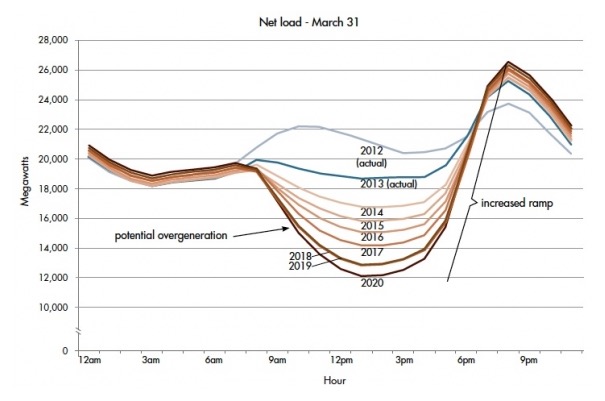
California’s most obvious solution to largely unmanaged, uncontrolled space cooling load is to “feed the duck’s neck” via energy storage of midday solar surplus. Without turning down late-afternoon and early-evening space cooling, “grid heat” will result in higher energy costs, suboptimal distributed energy, and overbuilt distribution infrastructure to avoid overloaded circuits and substations. This generally reflects economically inefficient distribution-asset utilization.
Commercial and residential air conditioning loads cause more than 30 percent of California’s total peak power demand in the summer — with an enormous and costly impact on the need for generation, transmission and distribution resources. California should embrace space-cooling loads that are highly correlated to system and distribution peaks. The state’s approach to space cooling loads generally lacks a systems approach that results in poor HVAC (heating, ventilation and air conditioning) design and installation choices that in turn lead to increased consumption and even more internal heat load that needs to be shed, often at times of local distribution peaks and critical peaks.
The combination is a pernicious problem throughout the residential and commercial HVAC industry. Deployed at significant scale and targeted at times of greatest system stress, efficient HVAC with demand response can free up dispatchable resources to improve both system reliability and renewables integration. By targeting key substations, DR-enabled efficient HVAC can provide a high-value energy resource — a win-win, improving grid operations while providing more efficiency and distributed resources.
In response to the recent closure of the 2,200-megawatt San Onofre Nuclear Generating Station, and with estimated retirements of 5,900 megawatts of once-through-cooling generating units coming soon, Southern California needs site-specific load and energy reductions sufficient in amount to contribute meaningfully and lastingly to local reliability requirements. Efficient HVAC in commercial buildings, enabled with demand response, is a logical starting point.
The good news is that energy efficiency’s value is widely recognized, with California forecasting twice as much economic energy-efficiency potential relative to what is being achieved. Also, we have the engineering know-how to reduce by significant amounts building loads via efficiency, demand response and other distributed resources.
What’s missing are the transaction structures to drive efficiency and demand response to scale. New transaction structures are needed to value “efficiency as energy” in order to create long-term (twenty to thirty years) capital investment opportunities. This is in stark contrast to our longstanding regulatory approach to efficiency based on short consumer payback requirements and uncertainty over the location and persistence of energy savings over time.
“Efficiency as energy” is site-specific and correlates well to circuit and substation loads. Energy savings of this magnitude can be valued for large capital market investment purposes. Trillions of dollars of investment capital are needed. California consumers, as both ratepayers and taxpayers, cannot foot this bill.
Instead of undermining the core utility business model, efficiency, demand response and distributed energy resources can be a powerful new utility resource and asset type. To scale and deploy efficiency as a new energy resource, we need to better match cash flows to support efficiency investments to the value efficiency provides. Just as kilowatt-hours may flow two ways, source to site and site to grid, capital market investments need to do the same.
If California fails to take advantage of energy efficiency and demand response that exists in abundance and has not yet been exploited, substantial grid investments will be required. This will breed customer reaction and flight from the grid, which will be too expensive. Customers increasingly will seek bypass options, through self-supply or microgrids.
***
Cynthia Mitchell is the principal of Energy Economics Inc., a Reno, Nevada-based consulting firm, and has been actively engaged in California on energy efficiency matters since 2000.
 Energy in Demand - Sustainable Energy - Rod Janssen
Interesting piece. I first learned of the duck curve phenomena from an east coast utility company executive making a presentation on how his utility sees geothermal heating and cooling systems (geoexchange) helping to smooth the curve out. Geoexchange is almost always the most efficient cooling system option available. These systems reduce peak demand on hot summer days and are not influenced by the changing level of insolation over the course of a day. Hence, if widely deployed they can help reduce the duck curve effect.
Coupling geoexchange systems with other renewable/sustainable solutions is an excellent way to amplify efforts to cut pollution, reduce GHG emissions and save energy. Compared to other parts of the US, California has been slow to adopt geoexchange. So as you push for CA to be more aggressive on energy efficiency, give some thought to promoting geoexchange.