
On the E3G website, Pepe Escrig, Leah Nyamey and Manon Dufour give an excellent briefing to prepare for the next phase of decarbonisation in the EU.
Making the EU’s climate and energy policy fit for the 2030s
Europe is entering a new phase of its climate transition. The upcoming review of the EU’s climate and energy framework is set to shape the direction of the transition in the decade ahead, at a time when decarbonisation is increasingly linked to energy security and affordability, industrial competitiveness and geopolitical priorities.
While the EU’s 2040 target of 90% was adopted, European governments are not aligned on how to get there – and increasingly focused on navigating geopolitical instability and a new energy crisis. Nevertheless, the opportunities are there for the EU to do what it has done before: find innovative ways to make decarbonisation a part of supporting other priorities.
Key features to get right
This review builds on a policy framework that has evolved through successive packages in the past decades, each reflecting both the political priorities of the time and the needs of a different phase of the transition. At each stage, progress has been the result of both policy innovation and political compromise.
This time, the revision will take place in a context of high energy costs, heightened international competition, geopolitical instability, calls for regulatory simplification and a growing investment gap. At the same time, the resulting framework for the 2030s will need to respond to a more demanding phase of the transition, where delivering emission cuts becomes more complex, costly and politically sensitive as it deepens across all sectors of the economy.
This creates an opportunity for the framework to respond directly to these pressures, by ensuring that it:
- Helps crowd in investment at scale and anchor the EU’s economic strategy, notably via an evolved Governance Regulation that facilitates implementation and investment clarity.
- Provides a stable and long-term foundation for Europe’s industrial transformation as the basis for greater economic resilience, with the EU Emissions Trading System (ETS) as a guiding market signal and revenue stream.
- Shields Europeans by accelerating the shift away from volatile fossil fuel dependence towards electrification and renewables, through revised Renewable Energy and Energy Efficiency Directives (RED and EED).
- Is leveraged as part of the EU’s external relations, aligning with key partners committed to a competitive clean economy and climate ambition, through the Carbon Border Adjustment Mechanism (CBAM) and a limited use of international carbon credits.
As decision makers work to reach the necessary compromises, to achieve a package fit for the 2030s they will need to build it on a foundation of predictability, coherence and credibility.
- Predictability: Ensuring regulatory stability now and into the 2030s
- Coherence: Joining the dots between the package files and beyond
- Credibility: Ensuring simplification and flexibility do not come at the expense of effectiveness
What you need to know
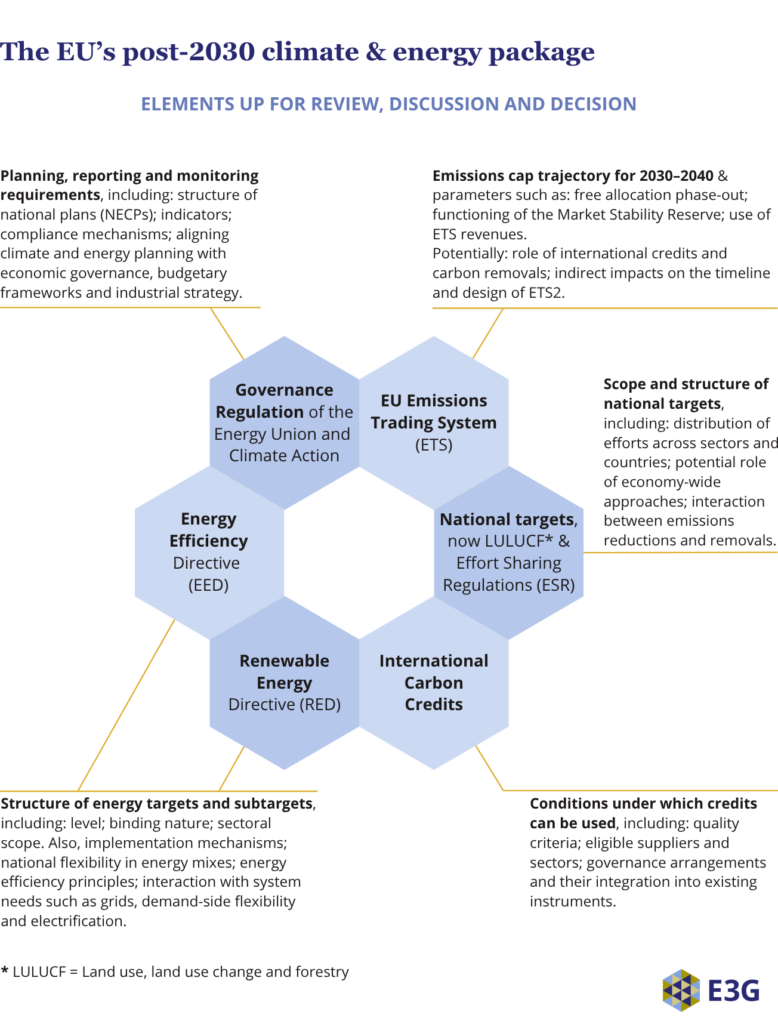
The post-2030 climate & energy package
The direction and effectiveness of the resulting package hinges on key choices across interconnected policy files. The outcome will not only shape emissions cuts but also the EU’s energy system, industrial transformation, investments and external action.
Key actors
The position of the EU countries during the 2040 climate target negotiations and recent discussions on the future of the EU ETS indicate that the review will be highly contentious. Amid pressure from parts of industry and continued support from progressive businesses and civil society, the Commission will try to balance long-term objectives with demands for simplification and flexibility. At the same time, the two possible Parliament majorities will simultaneously pull towards stability and rollbacks.
Political compromises will be needed to move the revision forward and secure enough political ownership of the new framework. 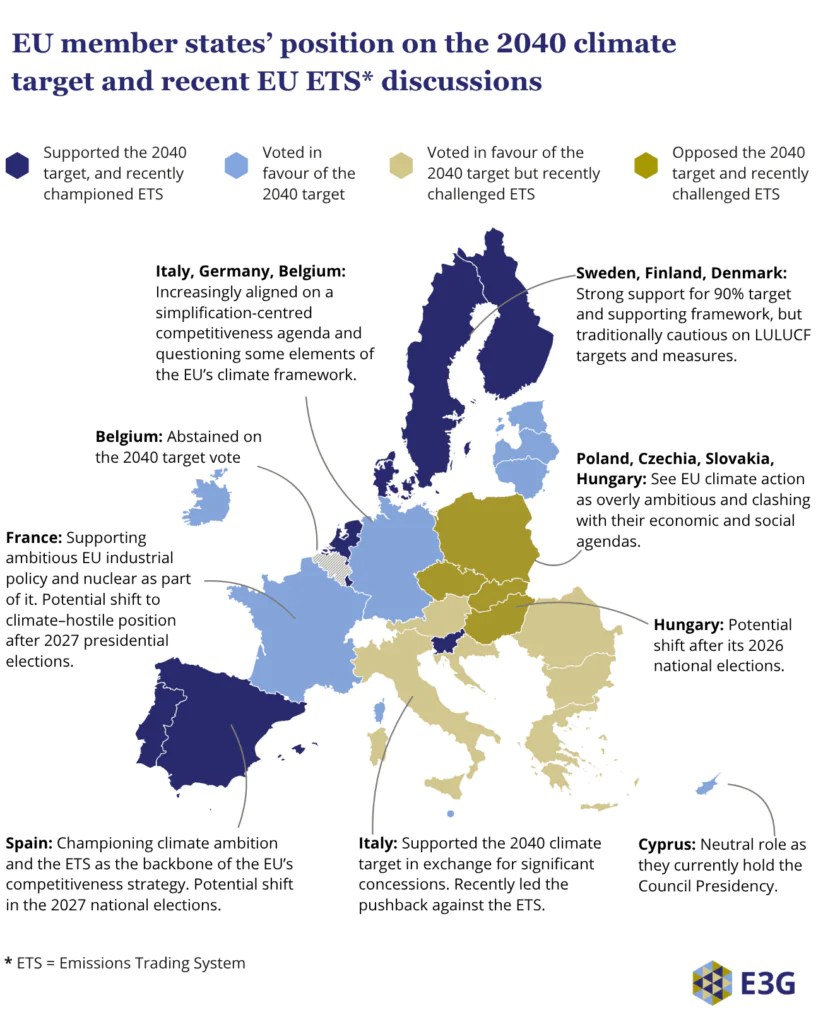
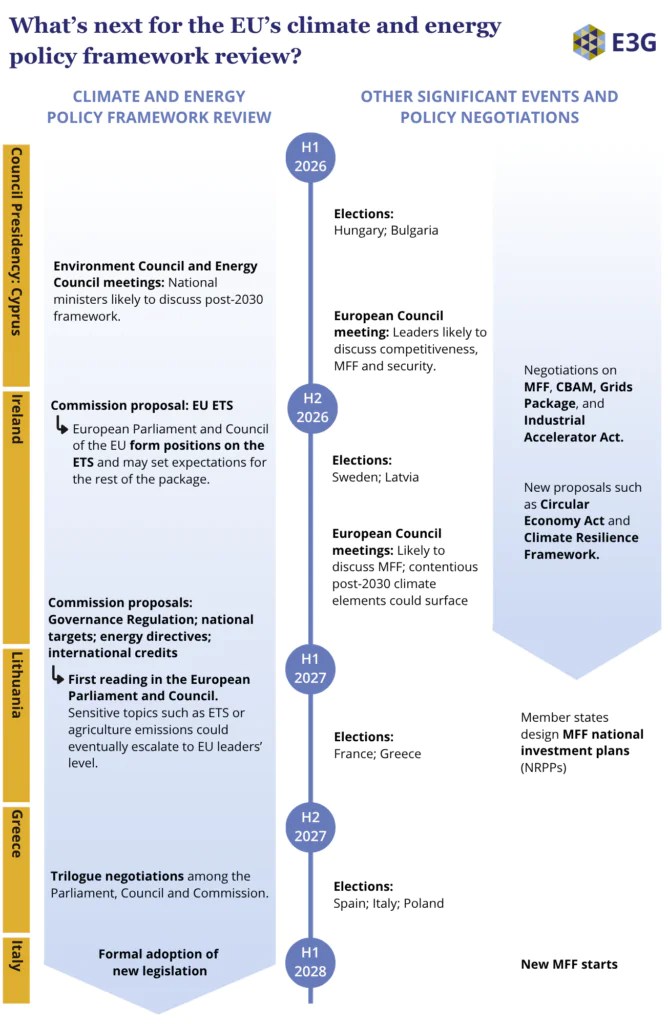
Indicative timeline
The review of the post-2030 framework is currently planned to start with Commission proposals in July (ETS) and December 2026 (Governance Regulation, national targets, energy directives, international credits). The Council and the Parliament may set expectations ahead of these moments and will discuss the content of the ETS revision in the second half of 2026 – at which point Europe is likely to be grappling with the impacts of an unfolding global energy crisis.
The remainder of the files will be discussed through 2027, a year marked by national elections in major member states. Discussions will intersect with parallel legislative processes – such as the negotiations on the Multiannual Financial Framework, the EU Grids Package and the Industrial Accelerator Act – and contentious elements could escalate to European Council summits of EU leaders.
The final adoption is expected at the end of 2027 or beginning of 2028.
You can download the briefing here as a pdf.
External link
 Energy in Demand - Sustainable Energy - Rod Janssen