
According to a March 2026 report on energy infrastructure resilience around the world, the electrical grid in Iceland has the lowest carbon footprint. A new study by Energy World Mag, a platform dedicated to recording the energy consumption, identified countries with the most ecological power grids, while also evaluating whether their energy systems are structured to maintain this advantage over time.
- Iceland has the lowest carbon intensity of electricity, with 28 gCO₂/kWh, meaning it is produced with the fewest emissions harmful to the environment.
- Around 61.4% of all energy consumed in Norway is renewable, which makes electrical grids easier to sustain.
- Switzerland records the lowest primary energy consumption with 0.51 kWh per $1 GDP, reflecting high energy efficiency.
The study analyzed 76 countries, examining how clean, efficient, and resilient their energy systems are (CESI Score). The research collected carbon intensity data for each country, which shows the intensity of emissions from electricity production. It also took into account the primary energy consumption per GDP, which shows energy efficiency, alternative and nuclear energy use, electricity production from hydroelectric sources, and how renewable energy use compares to the total consumption. All these factors reflect the diversity and reliability of the power grids, while fossil fuel energy consumption measures the reliance on non-renewable energy sources.
Here is how the top 10 countries where electricity has the lowest carbon footprint compare:
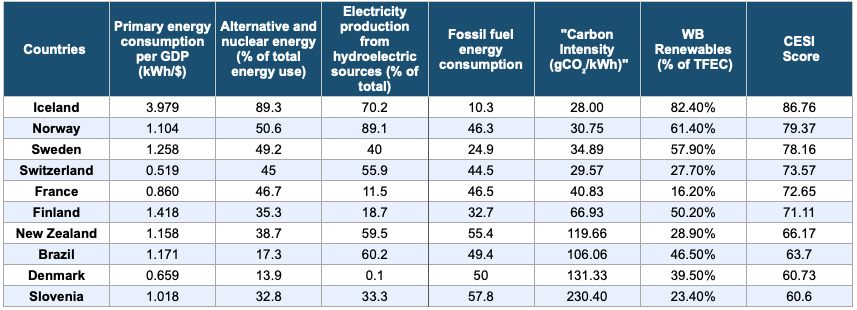
You can check the full report findings by following this link.
1. Iceland
- Primary energy consumption: 3.97 kWh/$ per GDP
- Alternative and nuclear energy: 89.3% of total energy use
- Electricity production from hydroelectric sources: 70.2%
- Fossil fuel energy consumption: 10.3%
- Carbon intensity: 28 gCO₂/kWh
- Renewable energy: 82.4%
- CESI Score: 86.7/100
Iceland’s electrical grid has the lowest carbon footprint in the world, with a carbon intensity of 28 gCO₂/kWh. This means Iceland produces the fewest emissions when creating electricity, which is three times lower than Austria and 12 times lower than Germany. Most of Iceland’s energy also comes from renewable sources (82.4%), and only 10.3% of electricity comes from fossil fuels.
2. Norway
Norway ranks 2nd, with half of the country’s electricity (50.6%) coming from alternative and nuclear energy. Norway also leans heavily on hydroelectric sources, and 89.1% of all electricity in the country comes from dams. Compared to Iceland, Norway has better energy efficiency, with the primary energy consumption of 1.1 kWh per $1 of GDP.
3. Sweden
Only a quarter of Sweden’s electricity comes from fossil fuels, with 24.9%, while renewable energy is responsible for powering 61.4% of the country’s power grid. Sweden also has low harmful emissions, recording 34.8 gCO₂/kWh, less than France, Finland, or New Zealand. The diversity of energy resources is one of Sweden’s main strengths, as 40% of its total energy comes from hydroelectric sources.
4. Switzerland
Switzerland shows the highest energy efficiency in the top 10. Only 0.51 kWh of energy is needed to create one $ of GDP, meaning Switzerland creates economic value using less energy than any other country. It also owns a diverse range of energy sources, from hydroelectric dams (55.9% of total output) to traditional fossil fuels (44.5%).
5. France
France has the fifth-smallest carbon footprint when creating electricity, with a carbon intensity of 40.8 gCO₂/kWh. The primary energy consumption for GDP creation is also low, and $1 of GDP requires only 0.86 kWh, the second-least in the top 5. While France still heavily relies on fossil fuels, 46.7% of electricity comes from alternative and nuclear energy sources.
A spokesperson from Energy World Mag commented on the study:
“Some of the world’s cleanest power systems benefit from geography as much as policy. Iceland and Norway sit on enormous natural advantages such as geothermal energy and large hydroelectric resources, and replicating their grid models elsewhere can be difficult. For other countries, building low-carbon systems without those advantages will require far larger investments in infrastructure and storage technologies.”
External link
 Energy in Demand - Sustainable Energy - Rod Janssen