
New OECD research finds that some firms use 20 times more energy than their peers producing the same output. Reducing the gap could cut industrial energy use by more than half using technologies that already exist. This blog post by Antoine Dechezlepretre and Josh De Lyon on the OECD website explores why these gaps exist and how targeted industrial, competition and energy policies can help close them.
While governments brace for another energy crisis, firms are leaving major energy savings on the table
The latest disruption to oil and gas flows is a reminder of a vulnerability that never fully went away. Global energy prices already tripled between 2020 and 2022, prompting OECD economies to spend around 0.7% of GDP shielding households and firms from the shock. Now, with supply routes under pressure again, the question of how firms use energy has become urgent in a new way.
The answer is: very unevenly. New OECD research shows that the gap between the most and the least energy-efficient firms within the same industry is vast, and that closing even part of it could more than halve industrial energy use and emissions without sacrificing output or waiting for new technologies. In a world of volatile energy markets, that gap is not just an environmental problem but one of competitiveness and economic security.
How do we measure the energy productivity of firms?
The research draws on official firm-level data for manufacturing firms with at least 20 employees across nine countries covering the period 1995-2021. For each firm, the analysis observes energy use alongside economic variables such as value added, employment, labour productivity and capital investment, and computes energy productivity as value added per unit of energy used – measured in physical terms (joules) rather than expenditure. This allows for direct comparison of how efficiently firms convert energy into output, independent of price fluctuations.
How big are the gaps in energy productivity between firms?
The variation in energy productivity is striking. Across all nine countries, firms at the 90th percentile of energy productivity generate roughly 20 times more value added per unit of energy than those at the 10th percentile. Put simply, where two firms consume identical amounts of energy, the frontier firm could produce 20 times more output. These gaps are four times larger than those observed in labour productivity.
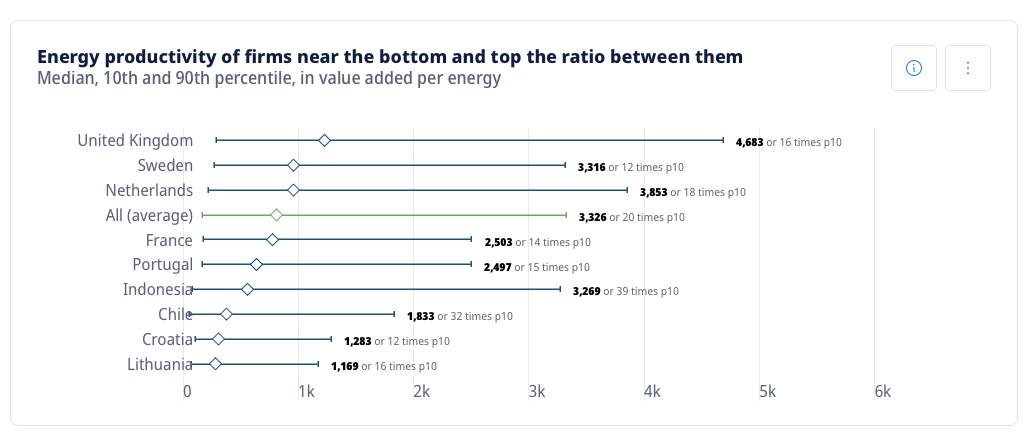
This spread signals a large and largely untapped opportunity to reduce energy use and emissions by helping lagging firms improve.
What would happen if laggards caught up?
OECD research estimates a conservative scenario: raising the quarter of firms with the lowest energy productivity in each industry up to the level of the 25th percentile. A realistic improvement still far from the frontier. The result, across all nine countries, is a 42% reduction in manufacturing energy use with no loss of output. Lifting all firms in the bottom half of the distribution to the median would cut energy use by 61% with comparable reductions in energy-related emissions.
These gains are possible across all manufacturing sectors but are largest in high-emitting industries such as chemicals, paper products, and non-metallic minerals including cement.
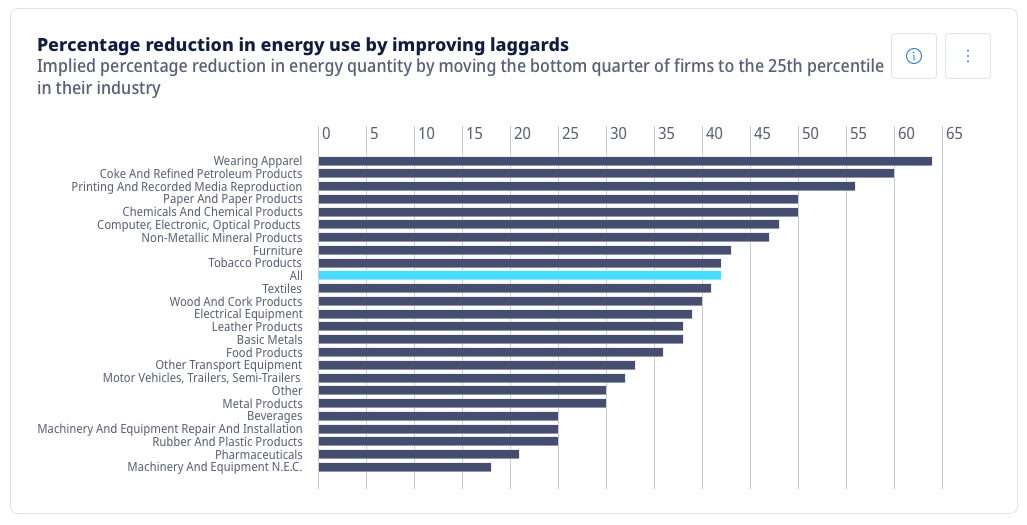
The implication is important: reducing industrial energy use and emissions does not depend on speculative technology breakthroughs. The production technologies and practices already exist and are in use by firms operating in the same countries and industries as the laggards. In other words, a large share of the potential reduction in industrial energy use and emissions could, in principle, be achieved simply by spreading current best practices more widely. The challenge is therefore not invention but diffusion.
Why do such large gaps persist?
Several factors explain why less efficient firms are not being forced or incentivised to improve. Younger firms and those using newer production technologies tend to be more energy productive. Larger firms often underperform on energy productivity, in part because their scale gives them market power to negotiate lower energy prices but also because, in many countries, they also benefit from reduced energy taxes or exemptions. However, lower prices reduce the pressure to improve efficiency, while simultaneously disadvantaging smaller, more energy-productive competitors.
There is a strong relationship between energy productivity and broader economic performance. Firms with higher labour productivity tend to have higher energy productivity, and improvements in one track closely with improvements in the other. This matters for policy design: investments in management, skills and technology adoption could deliver a “double dividend” with higher output per worker and more output per unit of energy.
How can policies help improve energy productivity?
Policymakers can use two key levers to drive improvements in energy productivity.
The first is fair energy and carbon pricing to incentivise energy productivity improvements. Rising energy prices are associated with narrowing gaps in energy productivity between firms, suggesting that price signals work when they apply broadly. Subsidising cheap energy as an industrial strategy for energy-intensive sectors may protect some firms in the short run but it delays efficiency improvements, disadvantages smaller, more efficient competitors and adds to fiscal costs. Broad-based carbon and energy pricing combined with targeted support for efficiency-improving investments is a more durable approach.
The second is fostering business dynamism and technology diffusion. Industries with stronger competition, better access to finance and more active innovation tend to show less dispersion in energy productivity. When inefficient firms face genuine competition, they upgrade or contract; when productive firms can access capital and grow, best practices spread. Policies that lower barriers to entry, strengthen competition policy, and support technology diffusion can support both growth and resilience.
The current situation makes the case for urgency. The production technologies to close the energy productivity gap already exist. The firms that embody best practice are already operating. What is needed is the policy environment to ensure that their example is followed.
External link
 Energy in Demand - Sustainable Energy - Rod Janssen
These statements from the OECD contains a very, very important revelationion that should be obligatory policy guidance for every single UN government:
“OECD research estimates a conservative scenario of raising the quarter of firms with the lowest energy productivity in each industry, up to the level of the 25th percentile….. results in a 42% reduction in manufacturing energy use – with no loss of output. ”
AND SO
“Lifting all firms in the bottom half of the distribution to the median would cut energy use by 61% with comparable reductions in energy-related emissions.”
I was so pleasantly surprised to see this analysis from the OECD. I fully agree with you. It should be obligatory policy guidance.