
Eurostat has put out the following article this week on the generation of electricity from renewables in 2024.
2024: nearly 50% of EU electricity came from renewables
In 2024, renewable energy sources accounted for 47.5% of gross electricity consumption in the EU, indicating a 2.1 percentage points (pp) increase from 2023. It has almost tripled (+30 pp) since the time series began in 2004. The share stood at 15.9% in 2004, increased to 28.6% in 2014 and jumped to 47.5% in 2024.
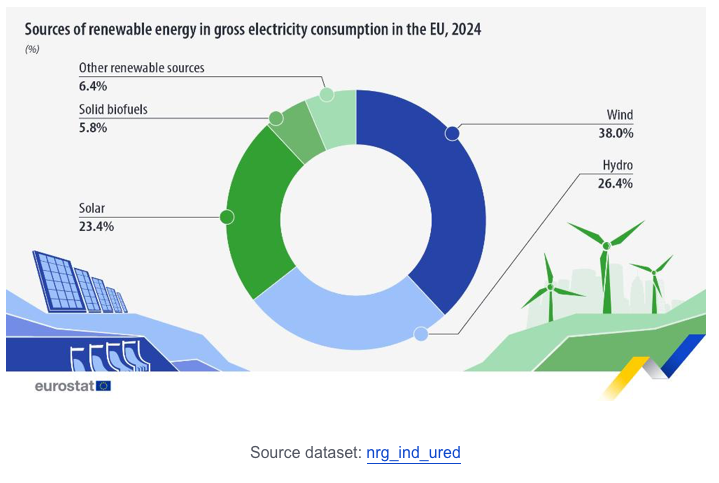
Wind (38.0% of the total) and hydro power (26.4%) accounted for almost two-thirds of the total electricity generated from renewables. Solar power followed, contributing 23.4%, while solid biofuels and other renewable sources accounted for 5.8% and 6.4%, respectively. Solar power is the fastest-growing source: in 2008, it accounted for only 1%, showing a robust increase from just 7.4 terawatt hours (TWh) in 2008 to 304 TWh in 2024.
Electricity from renewables dominates in Austria and Sweden
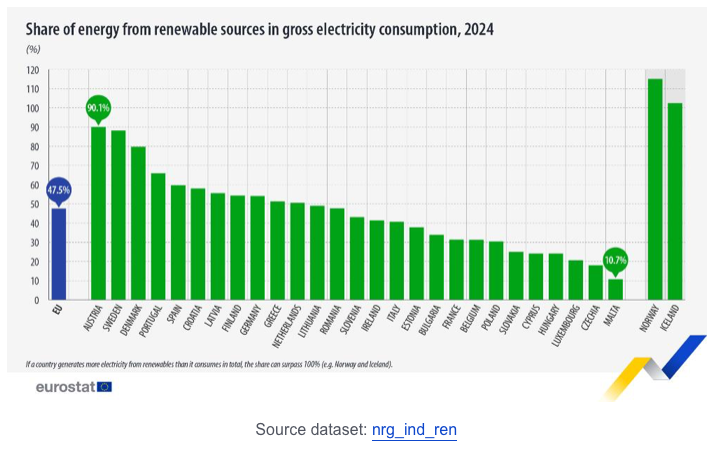
Data show that more than 75% of electricity consumed in 2024 was generated from renewable sources in Austria (90.1%, mostly hydro), Sweden (88.1%, mostly hydro and wind) and Denmark (79.7%, mostly wind). Shares above 50% were also registered in Portugal (65.8%), Spain (59.7%), Croatia (58.0%), Latvia (55.5%), Finland (54.3%), Germany (54.1%), Greece (51.2%) and the Netherlands (50.5%).
At the other end of the scale, the share of electricity from renewables was less than 25% in Malta (10.7%), Czechia (17.9%), Luxembourg (20.5%), Hungary and Cyprus (both 24.1%) and Slovakia (24.9%).
For more information
- Statistics Explained article on renewable energy
- Thematic section on energy
- Database on energy
- Interactive energy visualisations
Methodological notes
- Hydro power excludes pumping and is averaged over several years to smooth out the effects of meteorological variation (‘normalised’). Wind is also normalised. Solar power includes solar photovoltaics and solar thermal electricity generation. All other renewables include electricity generation from gaseous and liquid biofuels, renewable municipal waste, geothermal, and tidal, wave and ocean.
- If a country generates more electricity from renewables than it consumes in total, the share can surpass 100% (e.g. Norway and Iceland). In this calculation, the numerator represents the gross electricity production from renewable sources (normalised for hydro and wind), while the denominator accounts for the gross electricity production from all sources (not normalised), plus imports minus exports.
External link
 Energy in Demand - Sustainable Energy - Rod Janssen