
In an article on The Conversation website, John Kenny, Research Fellow (Public Engagement with Climate Change), School of Environmental Sciences, University of East Anglia and Lucas Geese Research Fellow, Tyndall Centre and School of Environmental Sciences, University of East Anglia, discuss a survey of British MPs that they undertook to understand their views on climate change. This is important, not only for Britain. What is the situation in your country?
We surveyed British MPs – most don’t know how urgent climate action is
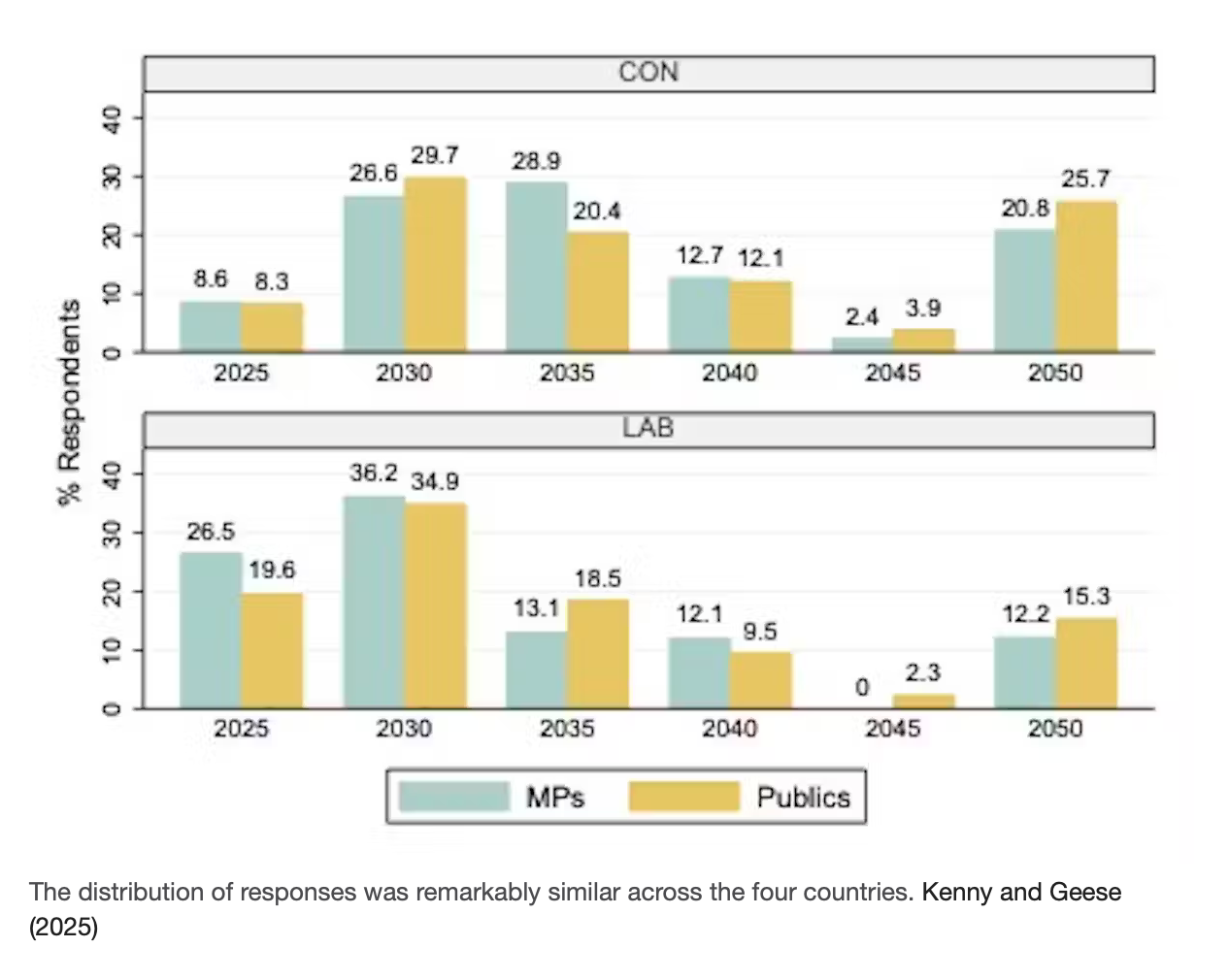
To keep global warming below 1.5°C, greenhouse gas emissions had to peak no later than 2025. That was a key finding of the IPCC’s most recent major report on the topic, published a few years ago. Yet when we surveyed UK MPs and members of the public in four countries, fewer than 15% could identify this deadline correctly.
This matters. If politicians and voters underestimate how urgently we have to fight climate change, they are less likely to back the tough policies needed. Instead, they risk assuming we have more time, all while climate change targets slip further out of reach.
Our study, published in the journal Communications Earth and Environment, found that across Britain, Canada, Chile and Germany, about one-third of respondents thought emissions only had to peak by 2040 or later. In the UK, we also surveyed MPs. We found Labour politicians were more likely than Conservatives to answer correctly, but overall awareness was low in both groups.
Among the public, younger people, those worried about climate change, and those less prone to believing conspiracy theories were the most likely to know the right answer. But overall, the pattern was clear: most people – and most MPs – don’t grasp the urgency of the situation.
Why awareness matters
Knowing the scientific facts does not automatically spur action. But political priorities are shaped by what MPs or their constituents consider as urgent (MPs sometimes cite a lack of urgency from constituents as an excuse for not taking climate actions even when they are concerned about it).
If neither MPs nor their voters realise how pressing the problem is, climate change risks being overlooked in favour of other issues. That MPs were largely not aware that much more immediate action was required may help explain why, by mid-2024, the UK was already behind the pace required to meet its own emissions reduction targets.
Partisan divides reinforce the problem. In our survey, 2019 Labour voters were more likely to know the correct 2025 deadline than those who voted Conservative. Political differences in knowledge were greater than the gap between MPs and the public, suggesting that party identity or political ideology, not just parliamentary expertise, is a factor in level of awareness.

The communication challenge
The IPCC and other big institutions produce authoritative reports, but they are not always written in a manner accessible to non-specialists. Policymakers are inundated with these reports and are expected to absorb huge amounts of information, digest it, and act on it. Crucial findings can get lost in the detail. If the urgency of climate action is not communicated clearly and memorably, it is less likely to be a factor in forming policy.
In the UK, scientists have long made “global greenhouse gases need to peak by 2025 for 1.5°C” a centrepiece of public and political communications. For example, it is there in the slogan of the Tyndall Centre, the major climate research hub where we work, that this is a Critical Decade for Climate Action.
But our findings suggest this message is not cutting through, with either politicians or the public. If deadlines are misunderstood, policies will inevitably not go far enough.
Make timelines impossible to ignore
The science is clear: emissions really did need to peak this year for a chance of staying within 1.5°C. A number of studies suggest this target is now effectively unreachable given the lack of substantial progress in recent years, but the urgency remains.
To close the gap between science and politics, communications must be sharper. Reports need to highlight timelines and consequences in ways that are impossible to ignore. Politicians and the public need to understand not just the scale of the climate crisis, but how immediate it is.
Many of those Conservative MPs were replaced by new Labour MPs in the 2024 election, so perhaps a repeat survey today would show greater awareness of climate change among parliamentarians. But even Labour MPs are still not very likely to appreciate the urgency.
External link
 Energy in Demand - Sustainable Energy - Rod Janssen
Unsubscribe please. Good stuff, but too much for my already overloaded inbox. Best, Robin
There is a problem for Labour MPs (or as the party is now known: LINO –
Labour in Name Only), they do not & never have counted for anything.
They have no power, no influence zilch. Their knowledge of how urgent
(or not) taking action on climate change is, is thus irrelevant. The
LINO gov is run by a combo of Starmer’s Chief of staff, an Irishman
called McSweeney (standing behind him is the warmonger Blair) and for
finance, the Finance Minister (Reeves) is chosen for her stupidity and
pliability wrt to taking orders from the UK’s finance sector. I am sure
there are some “nice” LINO MPS, they are & always will be both
irrelevant and powerless – barely even lobby fodder. That said, some
good news: at some point in the next 2 decades, London will face a
“proper flood” – most of the city south of the Thames will go underwater
and the finance sector eradicated. Good.