
A new study finds that investing just one-third of the Social Climate Fund, the EU could subsidise up to 20 million heat pumps across the EU by 2032. This would be enough to reach all energy-poor households in nine EU countries and slash EU gas demand by 11% — nearly as much as the EU imported from Russia in 2024.
The EU Social Climate Fund (SCF) could be a game-changer for Europe’s heating transition, accelerating the rollout of fossil-free technologies like heat pumps and solar thermal systems.
Commissioned by the European Environmental Bureau (EEB) and carried out by LCP Delta, the study finds that one-third of the SCF alone could pay for over 20 million heat pumps. Countries like Germany, France and Poland could use their share to provide one to every energy-poor household.
However, across the EU as a whole, this funding would cover only 65% of all energy-poor households, indicating the need to tap into broader ETS2 revenues. The study estimates that if Member States combine one-third of the SCF with one-third of ETS2 revenues — expected to exceed €260 billion — they could deploy 100 million heat pumps across the EU. This would not only shield households from fossil fuel price shocks, but also help the EU meet its climate targets for heating and cooling.


Impact varies across EU states
The study also highlights significant disparities across Member States. Countries like France, Poland, Portugal, and Germany could already support all energy-poor households using one-third of SCF funds alone, thanks to existing support schemes.
Others —including Italy, Belgium, and Czechia— will need to draw on additional ETS2 revenues to close the gap or improve national support policies to meet the same goals.
In contrast, Romania, Bulgaria, Greece, and Estonia are unlikely to reach all energy-poor households even when combining both funding streams. The main obstacles: weak national support frameworks, high electricity taxes, and limited incentives for clean heating.
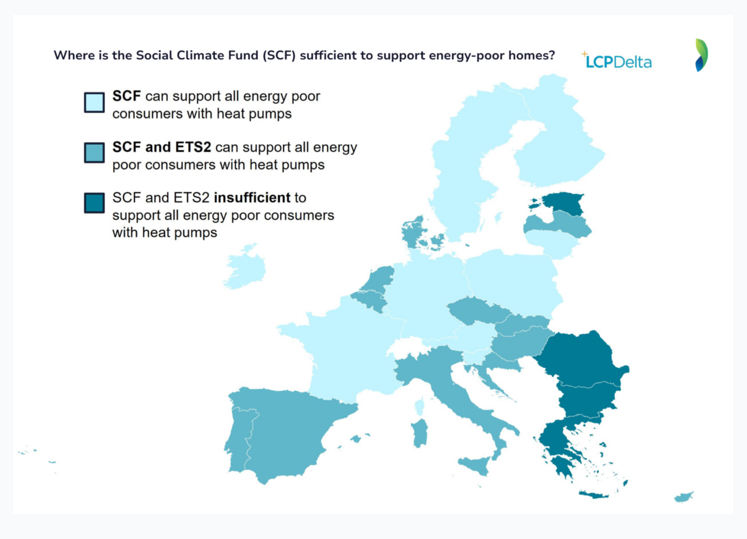
These differences reflect disparities in housing stock, energy taxation, and national support schemes across the bloc. In some countries, subsidised loans may be enough; in others, full grants are essential to enable households to make the switch.


Decisive moment for Member States
With National Social Climate Plans due by June 2025, experts are urging governments to prioritise clean heating —particularly for vulnerable households— when deciding how to spend this historic carbon revenue windfall.

External link
 Energy in Demand - Sustainable Energy - Rod Janssen