

Undoubtedly, executives of big companies are as pleased as could be. Many big companies have started to drop climate goals from executive pay plans, as reported by the Financial Times (behind a paywall). For example, the Swiss bank UBS’s annual report this week dropped language that linked executives’ pay to environmental, social and governance goals (ESG goals) and reduced the requirements for lower emissions in lending to real estate, power and cement by 2030. Standard Chartered removed references in executives’ 2025 annual bonus plans to cutting financed emissions in line with its 2030 targets. The FT says that none of the banks have dropped the ESG metrics entirely. UBS said it retained some “environmental and sustainability” metrics. Standard Chartered’s long-term incentive plan and annual group plan reference cuts to financed emissions. The bank says its “commitment to sustainability is unwavering and comes right from the top”. The European Commission’s new European Energy Efficiency Financing Coalition is expected to hold its first plenary in the next couple of months. Let’s see what the executives at those financial institutions say about their commitment there. One can only imagine.
On March 2nd EiD referred to the meetings of the Intergovernmental Panel on Climate Change (IPCC) and reported that there were no American experts present. According to Inside Climate News it turns out that five US researchers did attend “despite a series of directives from the Trump administration aimed at disengaging the US government from international climate coalition.” One scientist said: “For me, this process is so important that if I had to self-fund, I would.” Good for him and sad that they have to resort to this.
At last week’s energy conference in Houston, the President of the UNFCC COP28, Sultan al-Jaber, showed his true colours, in an interview with the Financial Times: While he says the agreement that came out of COP28 is still a useful tool, Jaber now describes himself as a “climate realist . . . I see that energy is essential and the enabler for our prosperity and economic growth”. And the interview ended with this: ““It is time to make energy great again,” he says, echoing the Trump line.”
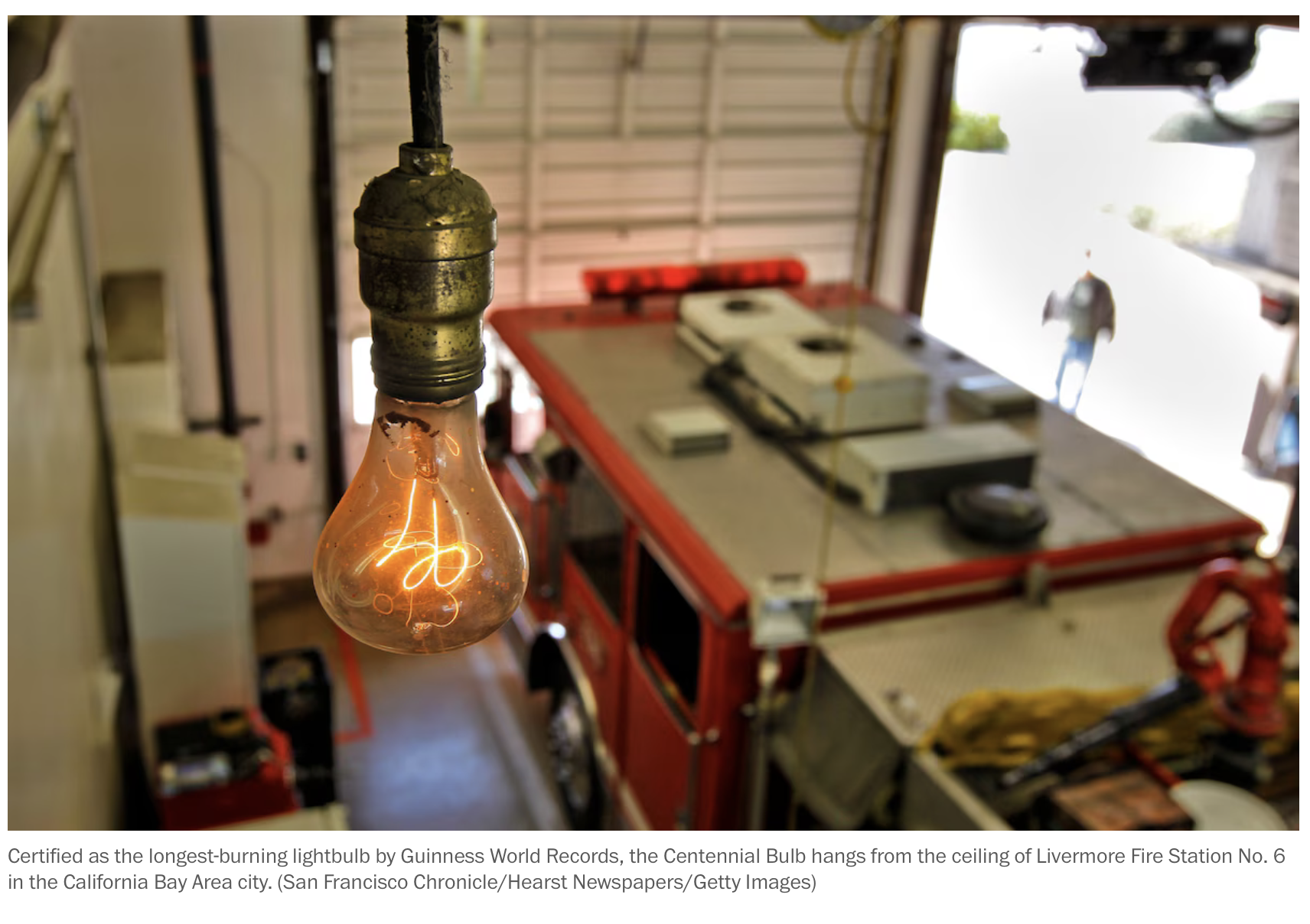
On a brighter note, the Washington Post reported that the Centennial Bulb is still illuminating after 124 years – yes, much more than a century. This lightbulb hangs over a firehouse in Livermore, California and was certified as the longest-burning lightbulb by Guinness World Records. Tom Bramell, keeper of the bulb, who retired in 2003 from the Livermore Fire Department said: “It’s not just a lightbulb. It represents the legacy, the history of a city. That thing is silently watching over us 24/7.” Long may it continue to shine.
In planning travel over the upcoming weeks, here are some useful ideas to help you along:
- Country Living Magazine provides 3 European train routes set to transform travel in 2025.
- Much Better Adventures provides us with 10 of the best winter walks in Europe.
- For those who want to combine hiking with food and wine in Europe and Australia, check out the Hedonistic Hiking website.
- Cycling for Softies provides us with the 15 Best Cycling Holidays in Europe 2025.
- Torino (Italy) is embracing a new era, transforming from an industrial powerhouse into a flourishing tourism destination: Torino Named European Capital of Smart Tourism 2025.
Fred Rogers (1928-2003), an American television host, songwriter and author, well known as the creator and host of the preschool television series Mister Rogers’ Neighborhood, explains about his heroes: “We live in a world in which we need to share responsibility. It’s easy to say “It’s not my child, not my community, not my world, not my problem.” Then there are those who see the need and respond. I consider those people my heroes.”
EiD welcomes your views about this week’s selection of posts on the zero-carbon energy transition:
- European Commission’s Action Plan to secure a competitive and decarbonised steel and metals industry in Europe
- New report from IEA and the Climate Club: Policy Toolbox for Industrial Decarbonisation
- Blog by Yamina Saheb – Sufficiency: The Equity Imperative
- Blog by Jane Marsh – Can Renewable Energy Hold Back the Floods? A New Era in Climate Protection
- Once upon a time electric vehicles were marketed as ‘women’s cars’
- Plans for ‘cutting-edge sustainable Scottish distillery that aims to redefine the future of whisky production
- Since the 1950s the Pentagon has poured support into climate and cold-region research to boost the national defense
- The American beef industry knew that raising cattle was a significant source of planet-warming emissions as early as 1989
- There is a new vulnerability of America’s electrical grid: unannounced disconnections by data centres
- Greenpeace hit with $660mn damages bill in US court over oil pipeline protests
Please send your comments on any of the posts. Please recommend EiD to your friends and colleagues.
If you know anyone who would like to receive this weekly notice, please have them contact EiD at energyindemand@gmail.com. It is not available on the WordPress website.
 Energy in Demand - Sustainable Energy - Rod Janssen
Nice post 🎸🌅