
Experts at Confused.com Energy have analysed the impact of Britain’s favourite meals are having on the environment’s carbon footprint.
Shocking carbon footprint of the UK’s favourite dishes
With 55% of vegans citing climate concerns as the main reason for limiting their diet, the environmental impact of our food choices is more relevant than ever. In fact, meal production and cooking alone can contribute up to 30% of a household’s carbon footprint.
But which beloved British dishes are the biggest environmental offenders, and which ones are the most energy-efficient to cook?
With a 170% spike in searches for “how to reduce your carbon footprint” over the past months as interest in greener habits surges, the experts at Confused.com Energy uncovered which dishes leave the largest environmental mark by analysing their ingredients’ emissions, appliances used in the recipe, as well as the cooking time.
Key findings:
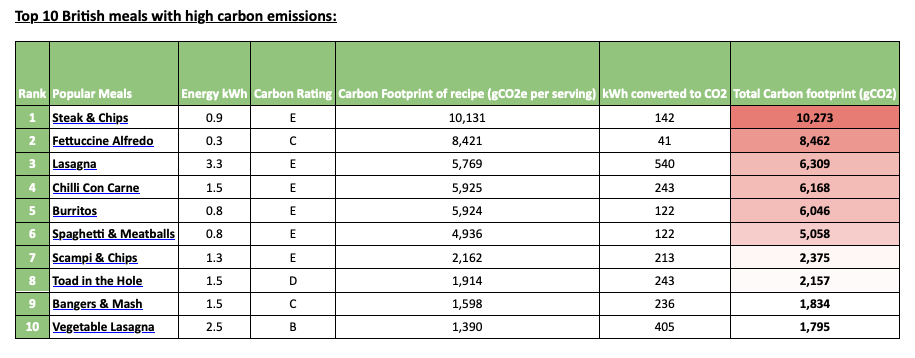
- Steak and chips creates the most carbon emissions (10,273 g CO2e) out of Britain’s most popular meals – equal to driving 73.4 kilometres.
- Nachos are the most energy-efficient using 0.125kWh per serving.
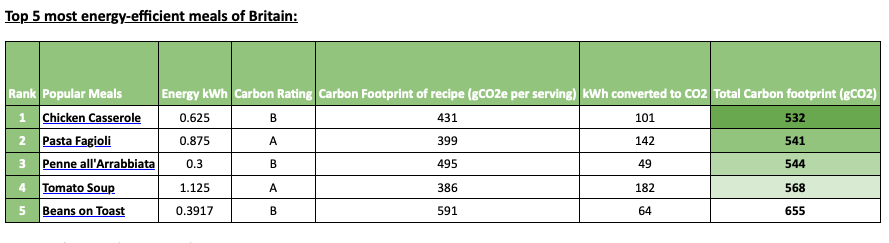
- Chicken casserole has the lowest carbon footprint of all meals (532 g CO2e) – equal to just 3.8 kilometres of driving.
 To access the entire dataset, view here.
Steak and chips has ranked as the ultimate British meal. But it has the highest carbon emissions during the cooking process, with a carbon footprint of 10,273 g CO2 per serving. While this is an outstanding amount, the majority of emissions comes from the recipe’s ingredients, as it releases only 142 g CO2 during the cooking process.
In second, fettuccine alfredo releases 8,462 grams of CO2 – the same as driving 60.5 kilometres. The ingredients have a whopping carbon footprint of 8421 g CO2, but the cooking emissions are relatively low at just 40.5 g CO2. This dish is in the top 10 for lowest energy usage, at 0.3kWh, taking just 10 minutes in total to cook.
Over four in five Brits revealed lasagna is one of their favourite meals. That’s despite it needing the most energy of all the meals we analysed (3.3 kWh) to cook. Lasagna can add 14p to your energy bill per serving, the Italian dish has a carbon footprint of 6,309 g CO2.
Chilli con carne emits an average carbon footprint of 6,168 g CO2. With a total cooking time of an hour, it uses a total of 1.5kWh of energy costing a total of 9.2 pence per serving.
Another Mexican delicacy, the burrito has an average carbon footprint of 6,046gCO2 which spans to 43.2 kilometres of driving.
 To access the entire dataset, view here.
Chicken casserole has ranked as the most energy-efficient meal, causing just 532 grams of carbon emissions and using only 0.625kWh of energy.
Pasta fagioli falls second with a carbon footprint of 541gCO2, three less than penne all’arrabbiata at 544gCO2.
The experts at Confused.com Energy commented:
“Cooking is responsible for nearly 14% of the electricity used in homes. So it’s crucial to find more environmentally friendly ways to enjoy our favourite dishes. To do this, try cooking multiple foods at once and meal prepping to reduce how often cooking appliances are used during the week.
“All foods have different greenhouse gas emissions, for example a kilo of beef emits 60 kilograms of CO2-equivalent emissions, while peas emit just 1 kilogram. Consider your food options. Try prioritising raw foods that do not need cooking and reducing your meat in-take. These can be great to help reduce your carbon footprint levels.”
Methodology:
- Confused.com Energy wanted to reveal the impact Britain’s favourite meals have on the environment’s carbon footprint, and which are the most energy-efficient.
- A seed list of the UK’s most popular meals were collated through YouGov. *Food items on the YouGov list that are not considered as a ‘full meal’ or did not show up as a recipe on BBC Good Food were not included.
- Recipes and cooking times of each meal were collected through BBC Good Food, the serving size and ingredients were taken from the original recipe and inputted into a free food carbon footprint calculator, My Emissions.
- The calculator worked out the carbon footprint (gCO2e) per serving and gave each recipe an overall carbon rating. *The values of the carbon footprint results are based on estimates of the emissions used from farm to store, including packaging and transport. This does not measure the emissions during storing, cooking or disposal of food.
- To calculate the serving cost in British pounds (GBP) and kWh usage, we used the UK energy price cap, which, as of recent, is around 24.50 pence per kWh.
- We then found the power consumption of all cooking appliances: oven = 2,000watts (W), microwave = 1,000W, toaster = 850W and electric stove top burner = 1,500W. *These assumptions are based on the idea that the meals are cooked using these three appliances only and are not inclusive of other cooking elements such as food processing.
- It was then estimated how long each appliance would be used per serving to calculate the energy usage with the formula: Energy (kWh) = Power
 x Time (Hours) divided by 1000. The formula converts watts to kilowatt-hours, which is the standard unit for energy usage in electricity bills.
 - To calculate the cost of each serving, we multiplied the total energy rate (kWh) by the UK energy price cap.
- For a full example of the workings: Tomato soup would have used a stovetop (1500W) for 45 minutes:
45 minutes converted to hours – 45/60 = 0.75 hours
Energy(kWh) = 1500W x 0.75hrs/1000 = 1.125kWh
Cost = 1.125 kWh x 0.245 GBP = £0.276
Cost per serving = £0.28/4 = £0.07
Total energy = 1.125 kWh
Total serving cost = £0.07p
- The energy usage (kWh) was then multiplied by the UK’s average carbon intesnsity of 162g carbon dioxide per kilowatt hour (gC02/kWh). This was then added to the recipe’s gCO2e to create a final carbon footprint for each meal.
- All meals were ranked based on which creates the most carbon emissions.
- All data was collected and is accurate as of November 2024.
 Energy in Demand - Sustainable Energy - Rod Janssen
Nice post 🌅🌅