
Det Norske Veritas (DNV), the international accredited registrar and classification society that provides services for several industries, including maritime, oil and gas, renewable energy, electrification, and healthcare has recently published its latest Energy Industry Insights report. They ask important questions: What defines an industry-leading energy organisation? The most profitable? The lowest emissions? The most adaptable? The biggest projects?
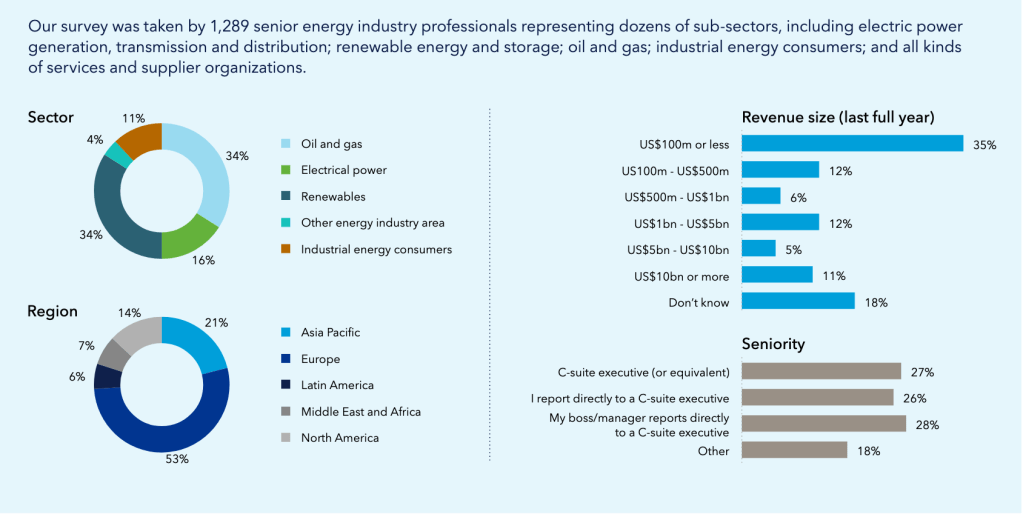
In their survey of almost 1,300 senior energy industry professionals, 28% said that their organisation is an industry leader in digitalisation and data-driven strategies, while 37% said the opposite. The report asks how this contributes to the performance, priorities, and outlook of these companies.
Their findings show Digital Leaders significantly outperform Laggards on various indicators, even beyond digitalisation:
- 87% of Digital Leaders are optimistic about meeting revenue targets, compared to just 55% of Laggards.
- 48% of Digital Leaders are optimistic about reaching decarbonisation/climate goals, versus 31% of Laggards.
- 83% of Digital Leaders believe they lead the industry in adapting to the energy transition, compared to 65% of Laggards.
Their research suggests that these — and several other success factors — are associated with excellence in one specific area: digitalisation. In other words, top organisations across many dimensions of business and operations are generally also industry leaders in digitalisation.
Digitalisation in the energy sector is the use of digital technologies to optimise energy generation, transmission, distribution, and consumption. It includes smart grids for efficient power supply, predictive maintenance in power plants, real-time data for energy-saving decisions, and myriad other applications.
Of course, many things contribute to success in digitalisation and those features — such as a culture of innovation, a strategic vision, or strong leadership — are likely to be factors that contribute to all kinds of success.
However, a timely and effective energy transition will be impossible without automation, data-driven decision-making, and digital innovations. This gives many digitalisation initiatives the same urgent priority as the decarbonisation of the energy system. It also makes it especially important for us to better understand, both how digital leaders have made progress, and why some organisations fail to keep pace.
The report is available here.
External link
 Energy in Demand - Sustainable Energy - Rod Janssen