
Global investment in clean energy is set to double the amount going to fossil fuels this year.
But developing nations are largely being left out of the renewable energy transition. Michael Purton writes on the World Economic Forum website how developing countries can benefit from the investments.
Clean energy investment is set to double that of fossil fuels – here’s how developing nations can also benefit
A major milestone is set to be reached this year in the fight to tackle the climate crisis – global investment in clean energy will reach almost double the amount going to fossil fuels. But while the shift to renewable power speeds ahead, there is a risk that millions of people could be left behind.
The International Energy Agency’s (IEA) 2024 World Energy Investment report says total global energy investment this year will likely exceed $3 trillion for the first time, with $2 trillion spent on clean technologies such as renewables, electric vehicles and nuclear power, and $1 trillion going to coal, gas and oil.
However, the report shows that the overwhelming majority of that clean energy investment is happening in Europe, the United States and China, with just 15% of the $2 trillion being spent in emerging economies, chiefly because the high cost of capital is holding back the development of new projects.
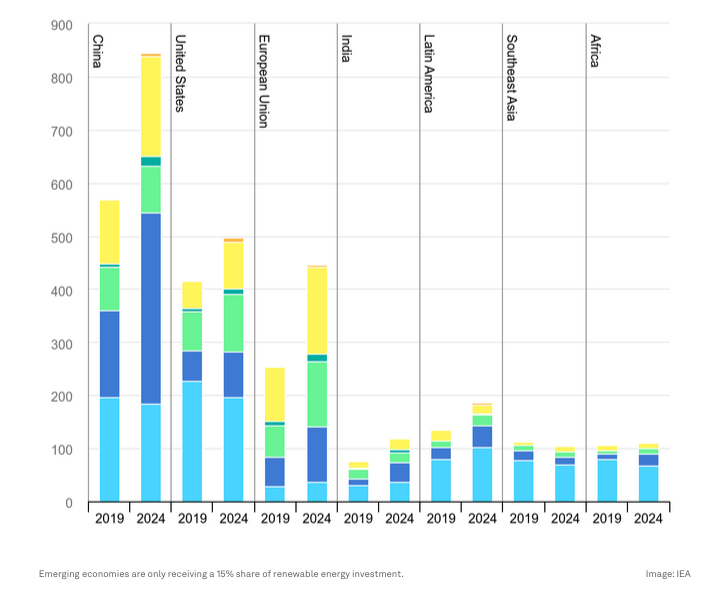
This lack of funding in developing nations means they are stuck in a loop: they cannot afford to build wind and solar farms, so they have to continue to rely on fossil fuel energy, which means they cannot reduce their emissions and therefore cannot combat climate change.
In the World Energy Investment report, IEA Executive Director Fatih Birol writes: “More must be done to ensure that investment reaches the places where it is needed most, in particular the developing economies where access to affordable, sustainable and secure energy is severely lacking today.”
The just transition
Ensuring emerging countries can develop renewable energy projects is one element of the ‘just transition’ to a world where global warming is no more than 1.5C above pre-industrial levels. Another aspect of that just transition is making sure that the phasing out of fossil fuels does not equal the phasing out of employment for millions of people currently working in industries related to oil, gas and coal.
The United Nations Development Programme says “the backbone” of the just transition is “ensuring that every person, society and country benefits from the opportunities presented by constructing future economies in line with the 1.5C global warming goal”.
While a World Economic Forum report, Fostering Effective Energy Transition, says an equitable and inclusive energy transition is vital because “all countries and people – at the individual, community, national and international levels” are affected.
The Forum report includes an Energy Transition Index (ETI), which benchmarks 120 countries on their current energy system performance, focusing on balancing equity, security and sustainability, and on their readiness to transition to clean energy.
While there has been notable progress in energy efficiency and a significant rise in the adoption of clean energy, the momentum of the transition “has been held back by setbacks in energy equity, driven by rising energy prices in recent years” and that “energy security also continues to be tested by geopolitical risks,” the report found.
External link
 Energy in Demand - Sustainable Energy - Rod Janssen