
In an article on The Conversation website, Dylan McConnell, Senior Research Associate, Renewable Energy & Energy Systems Analyst, UNSW Sydney discusses the impact of spilling excess power. Do you know what “spilled” energy is? If not, this article explains it.
Should we worry about wasting renewable energy? Here’s why ‘spilling’ excess power is expected – and efficient
In Australia’s electricity system, more and more energy from sunlight and wind is being “spilled” – or not converted to electricity.
In the last year, the amount of renewable energy spilled was roughly equivalent to the annual consumption of 750,000 typical households, or three months of consumption for the state of South Australia. Some have attributed these dynamics as being driven by a “solar power glut”.
At face value, this seems like a terrible waste of renewable energy, even more so in the face of a slump in rate of renewable energy growth and the pressing need to reduce emissions.
But the story is more complex. Such spillage, also known as curtailment, is also an expected and efficient feature of renewable energy systems.
What is ‘spilled energy’?
The energy market operator defines spilled energy as “energy from variable renewable energy resources that could be generated but is unable to be delivered”.
It represents energy that could have been converted to electricity, but wasn’t. The unconverted energy simply remains in the environment.
It is typically broken down into two categories, based on the cause of the spillage. Firstly, there is curtailment based on the operation of the transmission network. Power generation can be constrained due to operation limits or congestion in the network, resulting in spilled energy. This can occur when there are too many generators in the same area, trying to send power through the same transmission line. Secondly, a generator may reduce output due to low market prices, which the operator calls “economic spill” also known as “economic curtailment”.
The amount of this curtailment has been growing in recent years. In the last 12 months this curtailed energy represents more than 8.5% of the total potential. This varies considerably by region, with as much 12% spilled in Victoria in the last year.
Why is spillage efficient?
It doesn’t make economic sense to try and utilise every renewable electron. The cost to store, transmit and utilise every single watt of power from a renewable energy source would be exorbitant.
For example, we don’t build additional highway lanes to accommodate traffic for the busiest single hour on an Easter weekend. In a similar way, it doesn’t make sense to build transmission to ensure every single watt is transferred. This would be expensive and result in severely underused infrastucture. For the more common weather conditions – when it isn’t blowing a gale or in the middle of a sunny day – the network would be considerably oversized.
Studies that model energy systems primarily powered by renewables commonly find it is more economically efficient to build additional renewable capacity, and spill some generation when there is an abundance of supply above demand.
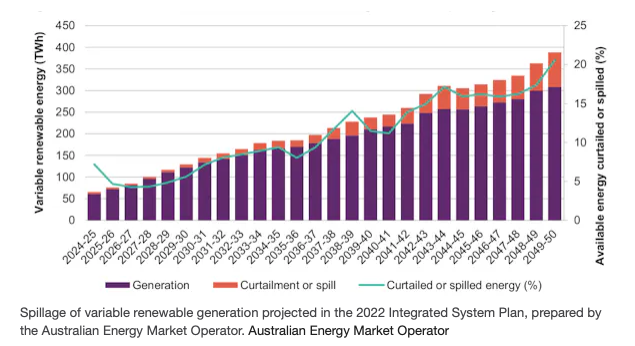
The Integrated System Plan, a roadmap for the electricity systemprepared by Australia’s energy market operator, projects an increase of renewable energy curtailment in the best case scenario. Approximately 20% of renewable generation is expected to be spilled by 2050. This is roughly equivalent to the current consumption of the state of New South Wales.
On one level, this shouldn’t be surprising.
Households often buy larger solar PV system relative to their consumption.
And it’s now common practice to install solar panels in excess of the capacity of the inverter to convert the power and send it to the home or grid. This is usually done to maximise use of the inverter and exports across a limited connection.
These two examples are broadly analogous to what happens on the grid, with economic curtailment and transmission-based curtailment.

Are current levels efficient?
At a system-wide level, current levels of spillage are above what was expected. The integrated system plan suggests curtailment rates of around 5% might be considered appropriate for today’s penetration of renewable energy, compared with the today’s level of around 8.5%. This difference relates to how things are working in the real world, including how rules around accessing transmission capacity currently work.
A recent discussion paper from the Australian Energy Market Commission highlights this mismatch, and suggest that “in the absence of reform, actual levels of curtailment are likely to exceed the levels forecast in the ISP”, pointing to issues with the current arrangements for generators accessing transmission capacity.
They imply the current system is resulting in higher than expected congestion, leading to increased costs for consumers and potentially unnecessary transmission builds. Managing transmission access remains a challenge for developers building new renewables projects.
Australia’s fleet of coal-fired power generators is another key driver of economic curtailment. While coal generators are more flexible than commonly understood, they have their limits. Specifically, they can only reduce operation down so far, to so-called minimum generation levels. Below these levels, they have to turn off completely, which is a costly exercise.
Coal generators therefore prefer to continue to generate, even at negative prices, rather than completely shut down. As a consequence, and to avoid paying to generate, renewable energy is spilled, rather than coal shutdown. In the context of the energy transition and the need to reduce emissions we actually have a glut of coal, rather than renewables.
Where to next?
The curtailment story is complex. On the one hand it is an expected phenomenon, and one we should get used to as we transition more toward a renewable-dominated electricity system. We should, however, be encouraging consumers to make use of this abundance of renewable generation where possible, such as by shifting their useage to the middle of the day.
On the other hand, some of these levels of curtailment are beyond what is expected. That’s in part because we still have an excess of coal power. We separately need to ensure grid congestion is properly managed, and access arrangements are reformed, to prevent unnecessary costs to consumers and renewable developers alike.
External link
 Energy in Demand - Sustainable Energy - Rod Janssen
I greatly doubt that curtailment of IRE (Intermittent Renewable Energies) is anywhere near ”efficient” !?
In fact, the investments in IREs should be curtailed and not their production (after someone has poured billions of EUR, USD in their capacities !…here I am talking about TSO – system operator – and not prosumers !)
Lets see why I think that way:
Catalin, Thanks so much for this detailed response. This really helps.
The article is nonsense from start to finish. First: most renewables projects are designed, financed and built based on ALL electricity from the project having a value – which is where the LCOE figure comes from. This is why govs in the EU (& even the UK) offer things such as Contracts for Difference (often coupled to constraint payments) – so that value for energy generated is guaranteed – without which few RES projects would get built.
The writer then builds a straw man argument – why build a power network for peak power. Well quite. Instead you install at substations, storage – batts or electrolysers to absorb surplus (peak?) power.
Moving on to Madam Dragostin’s comments and taking auction strike prices for wind and PV – Germany & Spain – these are in the range Euro50- to Euro30/MWh (respectively). Oddly these track LCOEs. They also track +/- typical (if one can use that word) wholesale prices. Given these realities (note that word) I’m interested to hear how this looks like “subsidies”. This view is shared by the likes of DG Competition – with whom I’m in contact from time to time.
On a related note – the UK gives subsidies to the fossil mafia of circa £17bn/year. For an industry that is ++100 years old. I am confident the level is similar in other countries. Perhaps we should be focusing on this part of the energy system?
Nuclear? In the case of Spain, one can see 1GW blocks of nuclear generation pulled off the bars usually around April, & until September. Because load drops off a bit, yes reactors need maintenance and yes, PV crowds out other generation. France? Rivers dry up or heat up & cause reactors to shut down. Thus the story vis-à-vis reactors is a bit more complicated (it always is).
Lastly, baseload such as “hydro, biomass, biofuels”. Was not aware that hydro (apart from run of river – use it or lose it) was base load – ditto “biofuels” but I guess one lives & learns. Not sure the EU “rejects” these technologies’. In the case of France, Germany etc – most of the hydro resource has been exploited. In the case of Spain, remind of the water situation again. So not so much “reject” as “fully exploited”.
I,ll try to reply to Madam Parr the follows:
PS…its good to be in contact from time to time with DG Competition…the problem is – do they hear you or listen to you, or, to put it the other way around…do they really understand ”competition” from somebody from the other side of the table ?
Gentlemen, thanks to both of you, Catalin and Mike, for your comments.
Rod, to make the things cristal clear and help Mike in his discussions with DG Competition and to keep him on a learning curve, I quote below from RED III , the ”smart” recommendations taken by our ”smart” authorities, concerning renewables:
”………………..
Article 15c
Renewables acceleration areas
1.
By 21 February 2026, Member States shall ensure that competent authorities adopt one or more plans designating, as a sub-set of the areas referred to in Article 15b(1), renewables acceleration areas for one or more types of renewable energy sources. Member States may exclude biomass combustion and hydropower plants….”
……………………….
So, for the particular case of Romania, unfortunately, we take the ”may” strictly for the following consequences are extremely detrimental:
All these above, are/could be ”base-load” generators, but instead, we are flooded with useless wind (now, we start with CfDs on Black sea, as if we have already exhausted all the inland resources !?!?) and PVs on agricultural land, intermittent, without storages (why not DG Energy finance PHPS-pumped hydro power stations in Romania !?…where we have huge resources ???) . Those PVs on agricultural land where there are some dogs watching around – and this is what we call energy economics and ”fair competition” from the lawyers in DG Competition.
If energy sector will be regulated by lawyers and politicians, then, this is the end !
Thanks so much for this, Catalin