
A recent article on the Cell Press website provides valuable insight into the impact of 100% electrification of domestic heat in the UK. Decarbonising heat in particular is often perceived as a daunting task since natural gas serves between 60 and 80% of the domestic heat sector in countries like the UK. While there has been steady progress in decarbonising the power sector, mostly through deploying renewable energy and replacing coal with gas generation, decarbonizing the heat sector remains an unsolved riddle on the energy agenda. Concerns over electrification often center on expected pressures on the power grid and the perceived need for a very significant increase in generation capacity by as much as 3-fold. While there is no silver bullet to decarbonize heat, we have shown in the present study that electrification of heat in conjunction with smart operation of thermal energy storage (TES) constitute a viable candidate without needing unreasonably rapid growth in overall system capacity although deploying TES at scale is challenging. The additional capacity needed would increase by roughly 40% without TES. The authors of the article are Vassilis M. Charitopoulos, Mathilde Fajardy, Chi Kong Chyong and David M. Reiner.
The impact of 100% electrification of domestic heat in Great Britain
Highlights
- Regional, hourly data reveals lack of synchronicity in domestic peak heat demand
- Overall peak heat demand derived here is almost 50% lower than widely cited values
- Interaction of electrification and renewable distribution leads to decentralized CCS
- Thermal energy storage technologies reduce required capacity additions by up to 40%
Summary
Britain has been a global leader in reducing emissions, but little progress has been made on heat, which accounts for almost one-third of UK emissions and the largest single share is domestic heat, which is responsible for 17% of the national total. Given the UK’s 2050 “Net-Zero” commitment, decarbonizing heat is becoming urgent and currently one of the main pathways involves its electrification. Here, we present a spatially explicit optimization model that investigates the implications of electrifying domestic heat on the operation of the power sector. Using hourly historical gas demand data, we conclude that the domestic peak heat demand is almost 50% lower than widely cited values. A 100% electrification pathway can be achieved with only a 1.3-fold increase in generation capacity compared to a power-only decarbonization scenario, but only by leveraging the role of thermal energy storage technologies without which a further 40% increase would be needed.
Graphical abstract
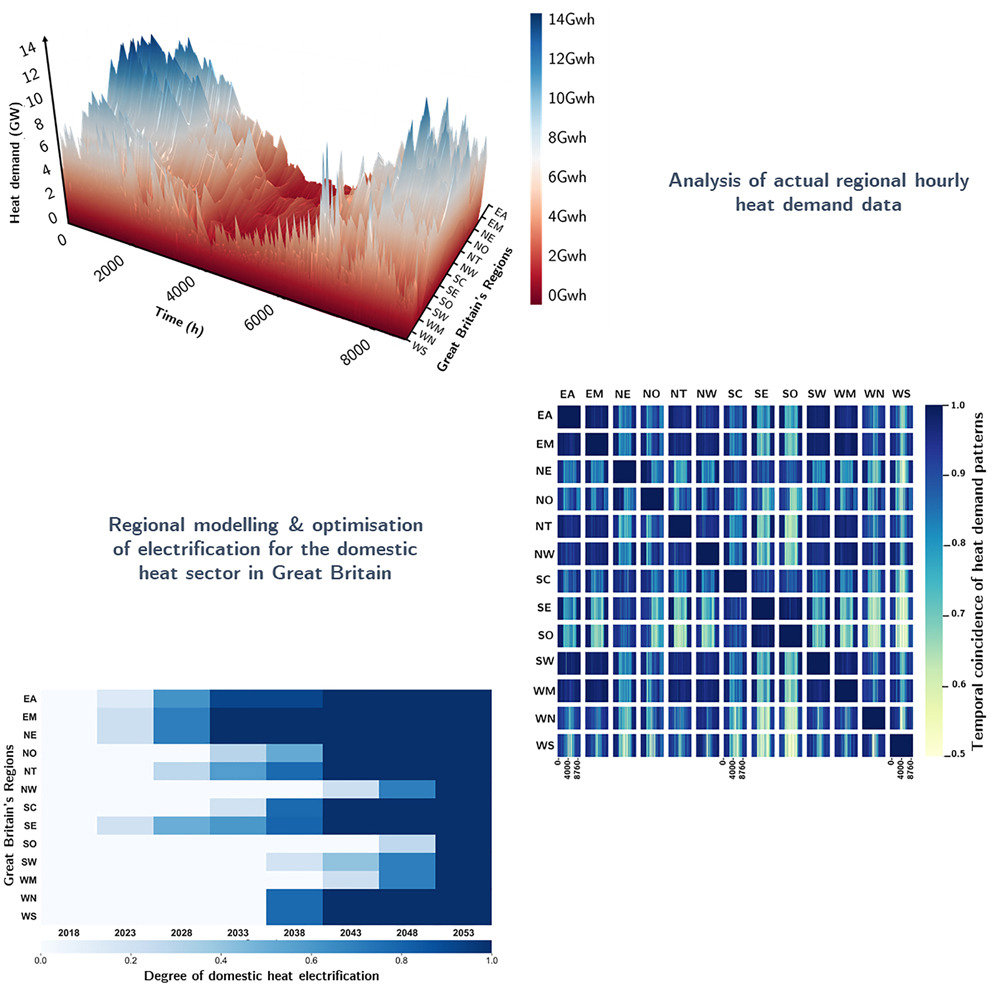
The full article is available here.
External link
 Energy in Demand - Sustainable Energy - Rod Janssen
I read the study & it is quite good at a macro-level/regional level. What it fails to do is grasp the “LV network” nettle. By this I mean, what happens when increasing numbers of properties
install heat pumps (GSHP or ASHP) on a given HV/LV network segment.
The answer is that a combination of under-voltage (due to load) and transformer overload occurs. The overload is “easily” remedied (bigger tx) the under-voltage is difficult and means replace existing cables with bigger cables. This is a non-trivial (and costly/time consuming) task. Heat storage/demand response does little to address this (robs Peter to pay Paul). The study is useful since it shows that at a macro level the amount of generation needed is not as great as thought. However, that was never the problem – the problem is local networks, designed based on ADMDs in the range 1 to 1.5kW. Installing an HP that uses 1kW of elec to deliver say 3kW of heat blows right through the 1 to 1.5kW design criteria – & this is before we even get to the impact of the home charging of EVs.
Thanks so much for this, Mike