
There are many briefs this week that you will no doubt find interesting and useful.
• new energy performance standard in the US for electric motors
EnergyLive News reports that businesses are expected to save $26 billion (£15.4m) on their utility bills by 2030 by implementing new energy efficiency standards for electric motors and walk-in coolers and freezers.
The US Department of Energy announced the standards which it claims could also cut carbon emissions by up to 158 million metric tonnes by 2030 – equivalent to the annual electricity use of more than 21 million homes.
Electric motors are used in a range of applications such as industrial machines and escalators, with a standard 30 horsepower electric motor using around 62,000KWh of energy every year. The new standard is forecast to save up to nearly $16 billion (£9.5bn).
The final efficiency standard for walk-in coolers and freezers could help cut energy bills by around $10 billion (£5.9bn), the Energy Department estimates.
Energy Secretary Ernest Moniz said: “Energy efficiency is one of the fastest and most cost-effective ways to save money, cut greenhouse gas pollution and help businesses strengthen their bottom lines.”
The Energy Department has so far finalised new efficiency standards for more than 30 household and commercial products, including dishwashers, refrigerators and water heaters.
• eceee industrial energy efficiency summer study
Please mark it in your calendar to attend the upcoming Summer Study, June 2-5th, in Papendal, Arnhem, the Netherlands. The theme is “Retool for a Competitive and Sustainable Industry.” It covers all types of industry, from manufacturing and food processing to heavy process industry, and it covers large companies as well as SMEs. There are six themes for the 2014 Summer Study:
– Programmes to promote industrial energy efficiency
– Sustainable production design and supply chain initiatives
– Matching policies and drivers: Policies and directives to drive industrial efficiency
– Undertaking high impact actions: The role of technology and systems optimisation
– The role of energy management systems, education, outreach and training
– Business models to improve industrial efficiency, global perspective.
On Thursday, July 5th there will also be a special workshop on financing energy efficiency investments in industry. Invited guests to give key statements at the workshop are Miguel Sanz of SUSI Energy Efficiency AG (Switzerland) and Stephen Hibbert from ING Commercial Banking. The workshop will be moderated by Rod Janssen and Luigi Meli, panel leaders for the Summer Study panel on financing and new business models. Information on the workshop is available here.
You can come and help EiD do some blogging and tweeting since Rod, together with Luigi Meli, will be one of the panel leaders for the panel on Business Models. Industrial energy efficiency is starting to get the attention from policymakers that it should have had years ago. The new Energy Efficiency Directive is a major step forward. The Summer Study will be an ideal opportunity to come and discuss the topic in a convivial and relaxed atmosphere.
More information on the Summer Study programme is available on the eceee website.
• BPIE event May 16th
On May 16th, the Buildings Performance Institute Europe (BPIE) held a workshop on renovation strategies together with the IFEU Institute in Germany and the state of Baden-Wurttemberg, that brought over 100 people together to discuss four case studies from Belgium, the Czech Republic, France and Germany. This was important because EU member states were to have submitted their long-term renovation strategies to the Commission by April 30th. As Oliver Rapf, Executive Director of BPIE, outlined at the beginning, only 11 member states have submitted their plans to date and for those that have, few have met the requirements under the Energy Efficiency Directive and most lack ambition. For that reason, the discussion highlighted some good examples but also reflected some of the difficulties in preparing – and delivering – such strategies. Soon the BPIE will have the presentations available on its website. For those involved in buildings performance policies and programmes, it will be well worth reading them and reflecting on where we go next. As stated a couple of times, this is the beginning of the process, not the end.
• air quality in Paris
The Metro newspaper reports that in 2013 air quality was slightly better than in 2012 but still very poor and significantly above European standards. Particulates from diesel vehicles are particularly bad and the report states that 1.4 million inhabitants living in close proximity to the major roads are particularly vulnerable. Airparif, the association that monitors air quality, says that at the current rate of improvement, it could take 30 to 50 years to reach European standards.
• energy efficiency in Nova Scotia
Generally, we hear little from the regions and that is true in Europe as elsewhere. This week, however, EiD found out about the work going on in energy efficiency in one of Canada’s maritime provinces, Nova Scotia.
In 2013, energy efficiency evolved from an off-the-radar concept to one that is front-and-centre for Nova Scotians. Efficiency Nova Scotia is the independent, non-profit organization helping Nova Scotians save. They are led by an independent Board of Directors and regulated by the Nova Scotia Utility and Review Board. It is well worth reading their annual report. Importantly, for every dollar invested in energy efficiency returns nearly $3 in energy savings. EiD also suggests you watch their YouTube video and how they explain why we should have energy efficiency. It is a good message.
• from IMF blog on Ukraine situation
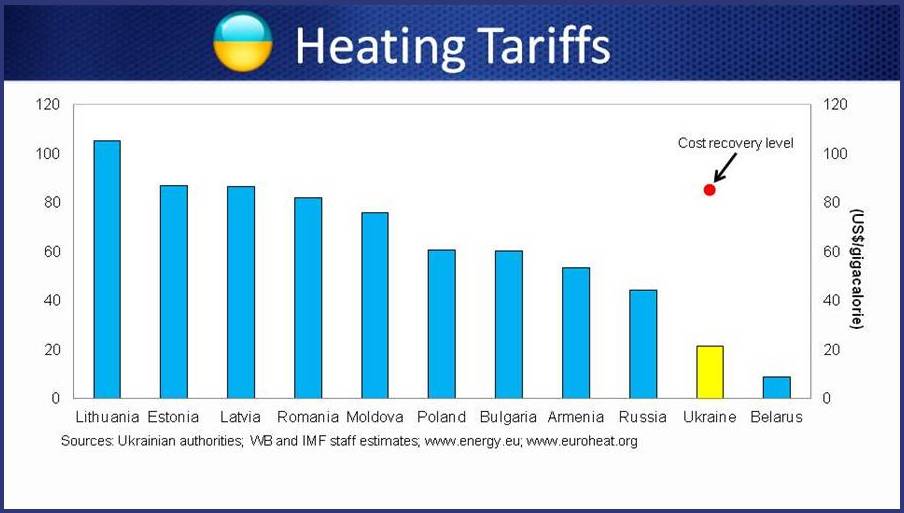
Reza Moghadam recently wrote a blog for the International Monetary Fund about stabilising Ukraine. The following is what he wrote about energy policy. Look at the diagram and the tariffs paid in Ukraine compared to neighbouring countries. As Moghadam says, this is untenable. Certainly, it is difficult to have tariffs that are significantly below the cost recovery level. Regardless of the final outcome over Russia, Crimea and east Ukraine, it certainly appears that reforms are needed.
Energy policy. Given the government’s precarious financial situation, its capacity to supply energy to the population at some of the lowest prices on the continent has become untenable. The price increases for heating and gas are eye-catching—40%-55% in 2014, and a further 20-40% in each of the next three years. But because these price hikes start from a low level, are spread out over time, and include provisions to protect the most vulnerable 25-30% of the population, their impact is less stark than the headline figures suggest. Overall, they raise heating and gas expenditures moderately from 3-7% of household budgets to 5-11%, reduce the deficit of the energy utility by only 1% of GDP by 2016, and recover costs starting only in 2018.
 Energy in Demand - Sustainable Energy - Rod Janssen