
Barbara Vergetis Lundin writes a good article in Fierce Energy about the economic rewards from energy efficiency investments in US programmes. It will be good to see whether other studies are finding similar results in Europe and abroad.
Energy efficiency investments reap three times the economic rewards
The Southeast Energy Efficiency Alliance (SEEA) has released the findings of its second Energy Pro3 Report, conducted by the Cadmus Group. The report evaluated the economic performance of SEEA’s 16-city energy efficiency retrofit consortium from 2010 to 2013. The research reveals that every million dollars invested in energy efficiency programs in the region generated $3.87 million in economic output and 17.28 new jobs.
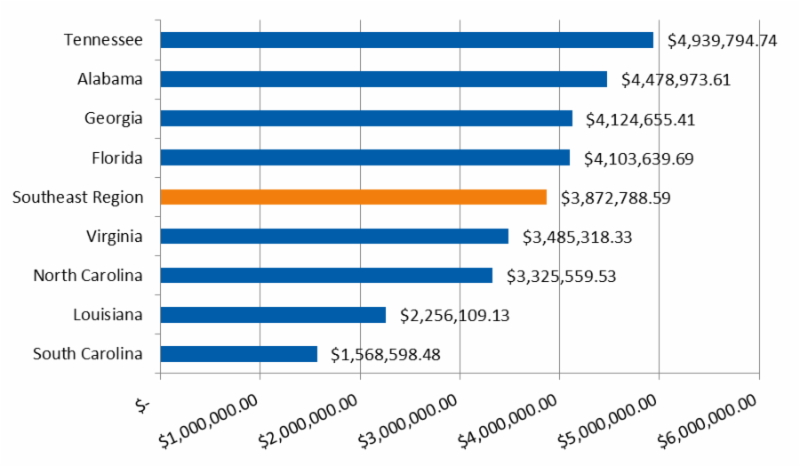
Output generated per million dollars of program investment.
The economic results were achieved by completing more than 10,000 building energy audits and 6,000 home and commercial building retrofits. The SEEA program consortium, funded by $20.2 million from the U.S. Department of Energy (DOE) Better Buildings Neighborhood Program (BBNP), ranked sixth among 41 BBNP programs nationwide based on the number of retrofits completed.
“The remarkably positive economic impact that investments in energy efficiency have had on both economic growth and job creation in the Southeast are helping to create a fundamental change in perspective,” said SEEA President Mandy Mahoney. “While this region has traditionally lagged the rest of the country in energy innovations, the results of this ‘grand experiment’ in community-based energy efficiency programming have validated the powerhouse economic effect of energy efficiency, a vitally important tool to ensuring the prosperity of the Southeast.”
The regional economic output resulting from DOE’s investment is comprised of three types of economic effects: direct, which reflect direct new spending in the economy; indirect, which account for spending needed to support the energy efficiency programs; and induced, which account for how households and workers spend on general consumer goods and services.
While program investment levels varied by states, all states with participating programs saw strong positive results with top-performing states benefiting at higher levels due to local program administration and spending; the availability of financing for retrofits; consumer education efforts; the presence of strong marketing support, utility partnerships, and workforce training and development; local market conditions; and existing market momentum.
In addition to achieving positive economic impacts from DOE’s investment in the region, throughout 2013, the Southeast also made significant progress in advancing energy-efficiency policy, including the passage of new, mandatory energy efficiency rules by the Mississippi legislature and the adoption of voluntary energy efficiency rules and a 2009 IECC-equivalent building energy code in Louisiana. Further, diverse stakeholders in North Carolina came together to successfully prevent a rollback of that state’s current progressive building energy codes.
New energy efficiency investments and public-private partnerships are currently underway in the region.
“SEEA’s unique analytical approach has yielded valuable insights into how investments in energy efficiency and conservation can also create jobs and other tangible benefits, even in regions that have historically shown little commitment to energy efficiency,” said Hossein Haeri, Ph.D., senior vice president in charge of Cadmus’ energy services. “In our experience conducting assessments of energy-efficiency programs nationwide, analyzing the economic impacts specifically associated with BBNPs as SEEA has done is promising new territory. We hope that SEEA’s example will provide a model for similar programs.”
The eport available here.
 Energy in Demand - Sustainable Energy - Rod Janssen