
 GreenWise is one of many news services to report on new research commissioned by the UK government showing that improving the energy performance of a house can add 14 per cent or more to its value
Energy efficiency upgrades could boost average home value by 14 per cent
The average home in England could see its value increase by £16,000 – or 14 per cent – through energy efficiency improvements, such as insulation, draught proofing and double-glazing, new research by the Department of Energy and Climate Change (DECC) suggests.
The study, which investigated the effect of Energy Performance Certificates (EPCs) on house prices, shows that energy saving measures are likely to have the biggest impact on house prices in the North East of England. Here, on average, a property’s value could increase by as much as 38 per cent if it’s EPC improved from a band G (not energy efficient) to an A or B (very energy efficient), according to the findings. In the North West, the value could increase by as much as 27 per cent. But in other regions, the research suggested the impact was much less, with London in particular only showing that energy saving measures were likely to account for a 12 per cent improvement on the price of a property.
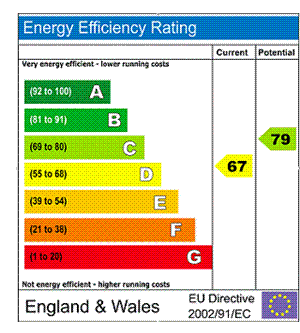
The research, released today, was described by DECC as the “most comprehensive” of its kind to date. It is being published just days before the department is due to release new figures about the Government’s flagship energy efficiency scheme, the Green Deal. The figures are expected to show that households are not investing in energy saving measures under the nationwide scheme at anything like the rate the Government needs them to to meet its target of insulating 14 million homes by 2020.
“We have long known the benefits of making energy saving improvements to the home, but this study is real evidence of the huge potential rewards,” Energy and Climate Change Minister Greg Barker said.
“The Green Deal is helping more people make these types of home improvements, reducing high upfront costs and letting people pay for some the cost through the savings on their bills. The Green Deal is a great option for anyone wanting to improve the look, feel and potentially the value of their home.”
The Green Deal helps households pay for some of the cost of making energy-saving improvements, with the repayments spread out over time and paid back through the electricity bill. But it has been criticised for not providing the necessary incentives for householders and figures released last month show the number of homes installing cavity wall insulation have, in fact, crashed by 97 per cent since the Government introduced the scheme.
Scope of the research
The research into EPCs and house prices examined over 300,000 like properties sold in England between 1995 and 2011. It found that currently, nearly half (46 per cent) of properties in England are band D, and that these properties could on average add potentially a further six per cent to their value if they reached a band A or B.
But while the research takes into account the price effects due to location, size and age of the property, it does not account for the condition of the property. Not all properties in a band D would have the potential to reach band A or B. And many properties would not be able to reach their potential under the Green Deal, because they would not be able to get the necessary finance to cover the cost of all the measures required.
But today’s research was welcomed by the UK Green Building Council, which described it as a “timely boost” for the Green Deal.
“This research provides evidence that the retrofit industry has been craving for a long time. Energy efficiency not only reduces bills and makes for a more comfortable home, but – like a new kitchen or bathroom – it can actually add value to the property as well,” John Alker, Director of Policy and Communications at the UK Green Building Council, said. “This puts the debate about payback of energy efficiency measures into context because it shows that the householder is likely to recoup their initial investment anyway.”
The research, which has not yet been fully peer reviewed, was carried out on behalf of DECC by a number of researchers at different UK universities.
 Energy in Demand - Sustainable Energy - Rod Janssen