
 The International Energy Agency recently published a report on Danish energy policies. The IEA in-depth review opens: “Denmark is a leader among OECD member countries in terms of renewable energy, energy efficiency and climate change policies.” This is obviously a winning combination.
The report sets the scene by stating that Denmark has a long history of consensus-based policy making and political stability and that this political consensus “has allowed a clear long-term vision to emerge, generally unimpeded by short-term political changes and changes in government. . . . It is indicative of the inclusive and open debate conducted by the government on energy policy that there is broad support among all stakeholders for the government’s long-term vision.” Not many countries have been so fortunate to have such a positive policy context.
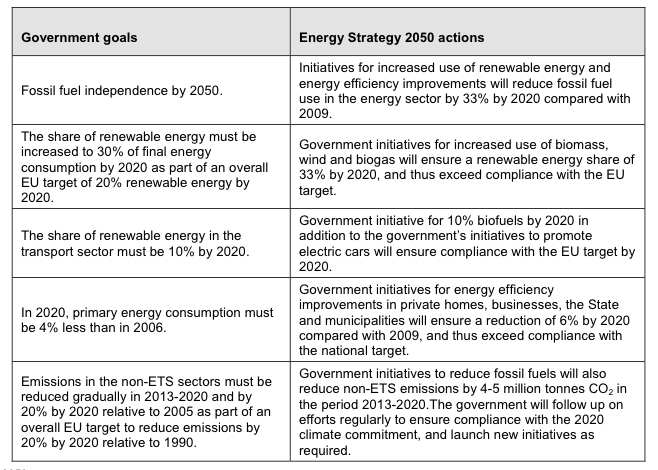
Energy policy is based on Denmark’s Energy Strategy 2050 that was published in 2011. The strategy sets the goal of making Denmark independent of fossil fuel use by 2050 and it calls for a major contribution from improved energy efficiency and renewable energy. The strategy is based on three phases: the transition phase; preparation and planning of the next phase followed by the utilisation and integration of new solutions; and the technology development phase, requiring investment in research, development and demonstration of cost-effective energy technologies followed by large-scale demonstration and preparation for market, and then finally market integration.
The goals and actions required are described in the following table.
Financing the transition will be achieved through a new revenue-neutral energy security tax on all fuels consumed for heating; a proposal for tax relief for energy use for industrial processes compared to what was envisaged in the “Spring Package” tax reform of 2009; businesses bearing increased costs that can be offset by increased subsidies for the purchase of more energy-efficient equipment; households paying the security of supply tax; a public service obligation; and a grid tariff. Energy companies will have greater obligations, financed through network tariffs. In fact, the report states that energy utilities will be the main actor “providing help to actual implementation of energy saving, especially in existing buildings and private enterprises.” Energy utilities have a permanent obligation to assist industry customers. From 2010, the savings derived from utility programmes will achieve 60% of the total annual energy saving target.
Denmark’s excellent institutions, such as the Danish Energy Agency and the Danish Energy Saving Trust, help in the analysis and implementation of the country’s strategy.
Energy efficiency
Denmark is praised for its efforts in energy efficiency with Denmark being a “world leader” when it comes to building standards. The building codes apply to both new and existing buildings. Current standards will be revised again in 2015 and 2020. Under the targets for 2010, all houses met requirements for low-energy houses (less than 50 kWh per square metre per year). Targets for 2015 and 2020 will have buildings at or below the passive house standard of 15 kWh per square metre per year.
The one weakness noticed by the IEA in Denmark’s energy efficiency strategy is that enforcement systems could be strengthened to maximise energy savings and to ensure credibility of its schemes. There is also room to improve policies promoting the financing of energy efficiency; and there is a need to promote the benefits of energy efficiency investments to financial institutions and to assist those institutions in developing energy efficiency investments for small and medium-sized enterprises.
Renewable energy
Renewables will play an increasingly important role in Denmark. Renewables currently provide about 21% of total primary energy supply and 34% of electricity production. While one of the global leaders, there is still scope for more development of wind power, both onshore and offshore. In the long term, Denmark expects that wind, in particular, will be able to compete with the costs of conventional electricity production. There will also be greater use of biomass, biogas expansion and the transition to green energy in the transport sector.
The IEA recommends that the government continue to support studies into the impact of large-scale integration of wind into the energy system and that these studies should be co-ordinated with work in neighbouring systems.
 Energy in Demand - Sustainable Energy - Rod Janssen