
 From a distance, and even inside Brussels, the process to put sustainable energy policies and programmes in place can be baffling. Here is an attempt to untangle the process for the draft Energy Efficiency Directive and the many voices trying to shape its final form.
The Energy Efficiency Directive was published in June 2011. The Directive has to be approved by both the European Parliament and the Council. Since last summer, the European Parliament’s rapporteur for the Directive, Claude Turmes MEP, has been putting together amendments to the Commission’s draft, with the help of a large support group. The Polish Presidency of the EU in the second half of 2011 was focused on preparing the Directive for Council approval, and the current Danish Presidency took over at the beginning of 2012.
Inevitably, there are many forces campaigning to make the draft Directive more ambitious, and many others trying to water it down. In this post, let’s consider the case to make the Directive more ambitious. Later posts will consider the opposite perspective.
The ‘more Directive is better’ lobby
The proponents of a highly ambitious directive divide into two main groups: energy/environment non-government organisations (NGOs) and the energy efficiency industries, such as insulation, glass, and energy management controls.
Among the leading NGOs are the European Environmental Bureau, WWF, Climate Action Network Europe, Friends of the Earth, Greenpeace as well as other smaller active NGOs.
On the industry side, there are many individual companies and trade associations as well as groupings of them. These include (and again, pardon the omissions) EuroACE, Eurima, Energy Efficiency Industry Forum, and many more. Some associations represent specific technologies. For example, Eurima includes companies in the rock wool insulation industry. EuroACE is an umbrella association made up of companies from the wide range of technologies from insulation to controls to glass and more.
Coalition for Energy Savings
In 2010, the wide range of associations joined together informally to create the Coalition for Energy Savings, mentioned in an earlier post. The Coalition brings together 23 business, professional and civil society associations. Its purpose is to make the case for a European energy policy that places a much greater, more meaningful emphasis on energy efficiency and savings. In particular it is arguing for the current 20% energy efficiency target to be binding. This is probably the first time such a broad “coalition” has been created to deal with Europe-wide issues.
The EU is expected to meet not even half of its energy saving target of 368 Mtoe by 2020. The gap is around 190 Mtoe. The Coalition has created a gapometer to monitor “progress” in the discussions. The Coalition prepares position papers, organises events, meets regularly with Commission officials or representatives from Parliament and Council and generally mobilises efforts to campaign for energy efficiency.
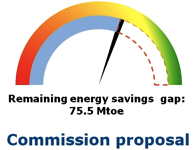
The Coalition recently held a workshop on “Energy Markets and Energy Efficiency: consumer costs and benefits” . . . and on February 7th there will be a Coalition event in the European Parliament on the employment potential of the Energy Efficiency Directive.
European Alliance to Save Energy
A second, separate grouping is the European Alliance to Save Energy (EU-ASE), which also happens to be a member of the Coalition. Its members include six major companies, one NGO (the Kyoto Club) and the European Climate Foundation. EU-ASE has a number of partners including the Alliance to Save Energy of the United States. It also organises events, prepares targeted publications and establishes positions on specific issues. According to the EU-ASE website: Many of these member organizations have radically changed their own business models and are taking the lead in deploying technologies and solutions throughout Europe and at a global level. EU-ASE enables these business leaders to join and work together to advance their common ‘cause’ of energy efficiency, foster good business practices and share ideas.
Coming up soon EU-ASE together with the Associate Parliamentary Renewable and Sustainable Energy Group (PRASEG) and the All-Party Parliamentary Fuel Poverty and Energy Efficiency Group (FPEEG) will organise a panel debate in the House of Commons in London on 28 February, 2012 to discuss Why the UK needs a European framework for energy efficiency.
The opportunity to make meaningful comment in Brussels has changed radically over the past decade. Those on the “ambition” side are much more organised, focused and co-ordinated than they have ever been in the past. Is it enough to close the gap? Time will tell. Member States are struggling with many competing priorities, and it is understandable that the financial crisis is upper-most. But there is a political will and an increasingly strong lobby to keep the focus on a low carbon economy.
– – –
The Industry, Research and Energy Committee (ITRE) of the European Parliament will be holding a vote on the EED on February 28th, one of many votes on the Parliament’s (and Mr Turmes’ and others) proposed amendments.
EiD will follow the approval process of the Energy Efficiency Directive and, occasionally on specific events relevant to the process. And, yes, EiD will report on the ‘less Directive is better’ side too, in order to get a balanced understanding of the complexity. As an earlier post stated, it is time to listen – and to learn.
 Energy in Demand - Sustainable Energy - Rod Janssen